Showing posts sorted by relevance for query manning caribbean union. Sort by date Show all posts

Thursday, June 24, 2010

PM Kamla: The people will decide future of political, economic union with OECS states

(Caribbean leaders sign political, economic union documents in Trinidad in 2008)

Prime Minister Kamla Persad-Bissessar told reporters Thursday Trinidad and Tobago will only enter into a union with other countries in the CARICOM region if the population agrees to such an arrangement.

Her predecessor, Patrick Manning, had made a commitment for a economic union with three Organisation of Eastern Caribbean (OECS) states to be followed by a political union by 2013.

The economic integration deal with Grenada, St Vincent and St Lucia was supposed to take effect in 2011. The memorandum of understanding for the union was signed in Port of Spain in August 2008 and endorsed by CARICOM leaders in May, 2009.

Persad-Bissessar explained to reporters the Parliament never had an opportunity to debate the political union which Manning had proposed and it was not presented to the people.

Manning had mounted a regional shuttle visit to several CARICOM countries to sell the integration idea but got a cold shoulder from Belize and Jamaica. He dismissed that and announced that the 2012 election would be a 'referendum' on the political union.

Read the story:
2012 election to be 'referendum' on political union: Manning
Related story:
Grenada PM makes case for greater Caribbean unity
Related story:
Manning committed to development programs, regional economic union
Related story:
Manning's political union gets more members

Manning, of course, didn't make it to 2012, leaving the matter to be decided by his successor.

"I am of the firm view that any such arrangement, or proposal, must be one that must get the consent of the population...That was never done, and therefore it is one that has to be totally reviewed,” Persad-Bissessar told reporters.


However she said her Government is committed to regional integration and the Caricom Single Market and Economy (CSME).

She said cabinet would review the specific proposals outlined in the integration documents which were submitted to CARICOM leaders last May.

Persad-Bissessar will lead the Trinidad and Tobago delegation to the CARICOM summit next month in Montego Bay, Jamaica.

Monday, June 22, 2009

Manning committed to development programs, regional economic union

Patrick Manning rallied his troops Sunday telling supporters of his governing People's National Movement (PNM) Trinidad and Tobago is moving ahead with its development programs, despite the global financial problems.

Speaking at a special convention in Chaguaramas, the PNM political leader avoided the nation's serious crime problem and the growing army of jobless and instead boasted that unemployment and poverty rates have dropped.

He pointed out that unemployment in the last quarter of last year was 4.2 per cent but admitted that with the economic downturn, unemployment is now slightly higher, between five and six per cent.

He was quick to point out that even with the loss of jobs the country was much better off that those in the region. In St Vincent, he said, unemployment has reached 18 per cent, adding that it is between 15 and 20 per cent in most of the other Eastern Caribbean islands.

On poverty he said Trinidad and Tobago remains at 16 on the global index while it ranges between 20 and 37 per cent in the Eastern Caribbean.

Manning said it is clear that the country is in a much better position than its Caribbean neighbours and suggested that future progress depends on whether Trinidad and Tobago goes ahead with the formation of a political entity with other Caribbean countries.

The Prime Minister said the struggling Eastern Caribbean economies pose a serious threat to the Trinidad and Tobago's economic welfare and the well-being of the people, and warned of the threats of mass illegal migration from the Eastern Caribbean states into Trinidad and Tobago.

Manning said such movement of people could cause an increase in drug activity and run the risk the development of narco-states in the region, which would lead to a decline in the Trinidad and Tobago manufacturing sector because of the loss of trade in the region.

"Whether we in Trinidad and Tobago like it or not, we cannot stand idly by and watch the Caribbean in this economic situation and do nothing about it. We will pay in blood for taking such a position," he declared.

Manning said economic union would bring increased economic activity in the entire region - both in Trinidad and Tobago and in the countries of the Eastern Caribbean.

He said the people of Caribbean would likely move to Trinidad and Tobago seeking a better life and warned that "We are not going to have enough police officers to stop the influx of illegal migrants into Trinidad and Tobago."

He said such an unplanned influx of illegal aliens would place enormous pressure on the social services, including housing, education and health services. That's why it is better to do it right and enter into a union with those countries, he said.

"So when we say we want to enter into an arrangement with the Eastern Caribbean, it is not to satisfy anybody's ego, my dear friends. It is a realisation that if we don't go it, we don't do it at our own peril," he said.

Manning also spoke about local government elections, noting that he is ready to take on and defeat the opposition.

Monday, March 3, 2008

Manning, Caribbean leaders discussing political union

Trinidad and Tobago Prime Minister Patrick Manning and some of his regional colleagues have been talking about a four-nation political union involving Trinidad and Tobago, Grenada, St Vincent and the Grenadines and St Lucia.

The talks are still in the initial stages. But Manning is on record as saying that Trinidad and Tobago's position is clear - greater unity is a must for the Caribbean region.

"We welcome political integration in the Caribbean and we make ourselves available for discussions on this matter and we will be part of any discussions that will advance that course," he told reporters.

St. Vincent and the Grenadines Prime Minister, Ralph Gonsalves, who held talks in Trinidad last week with Manning, is looking forward to a union.

Gonsalves told reporters following his two-day meeting with Manning that any political union between countries must be "structured in some formal institutional arrangements."

He indicated that former St. Lucian prime minister Dr. Vaughan Lewis, and former Trinidad and Tobago cabinet minister Dr. Cuthbert Joseph will likely conduct a study of the matter.

Neither Manning nor Gonzalves is saying exactly what is planned and why they believer a closer union with the four countries is needed when CARICOM already exists as the umbrella organization for regional unity and cooperation.

Gonzalves told reporters, "All of us know we cannot continue the way in which we have been going, but yet we don't want to think outside the boundaries of our individual sea and landscape....For my part, the words political union are not bad words."

Monday, September 28, 2009

Grenada PM makes case for greater Caribbean unity

(Caribbean leaders at signing of MOU for political and economic union with T&T)

Grenadian Prime Minister Tillman Thomas made a case in new York Sunday for deepening the regional integration movement.

"When you look at what’s happening around the world and, in particular, this present global economic crisis, clearly, we need to have a more unified or regional government in the region," Thomas told a town hall meeting Sunday evening in Brooklyn.

"We need to have a more regional approach to governance in the region," he said, citing the cost of regional representation abroad.

Thomas noted that the positions taken by most CARICOM member states at the United nations are similar.

"When you think about world issues and think about how Grenada or Trinidad or Jamaica or St. Vincent would vote, generally, the position is quite similar...I’m saying, look, we could come up with a structure – it’s a regional government.

"We could have one representation at the United Nations representing the region. That’s a possibility," he added.

"Look at the United States, look at Europe, look at other countries how they’re coming together. We have a common language, a common tradition, a common culture.

"All we need to do is improve our sea transportation and air transportation within the region. We can come up with a regional government. It’s not difficult to achieve. It’s been achieved in other countries," he said.

Thomas urged Caribbean nationals in the Diaspora to "help advance that cause," adding that in Brooklyn, "a Caribbean man is a Caribbean man – whether you’re from Trinidad, Jamaica or Grenada."

Trinidad and Tobago signed a memorandum of agreement with Grenada, St Vincent, and St Lucia in August last year for a political and economic union.

Prime Minister Patrick Manning has argued that such a union would benefit everyone and improve the lives of citizens in the three countries as well as those in Trinidad and Tobago.

Read the story: Manning committed to regional union

He has said the 2012 general election would be a referendum on the issue.

Read the story" 2012 election to be referendum on political union

Related story: Is Manning making Grenada a colony of T&T

Wednesday, July 1, 2009

CARICOM summit to tackle Barbados immigration, TT-CARICOM issues

Heads of Governments from the Caribbean Community (CARICOM) begin their annual meeting in Guyana Thursday with a packed agenda that includes discussions on the global economic crisis, Swine Flu and the strengthening of the regional integration movement.

The discussions will focus on Trinidad & Tobago's planned political union with Eastern Caribbean States, which have been criticized as possibly undermining CARICOM, and Manning's
stimulus package to strengthen economic development in selected CARICOM countries.

The economic plan will see a cooperation between Trinidad and Tobago, Jamaica, Dominica, Grenada and St Vincent and the Grenadines.


Read the story: Manning outlines Caricom-TT stimulus plan


Manning said last month a union with smaller Caribbean states would bring increased economic activity in the entire region - both in Trinidad and Tobago and in the countries of the Eastern Caribbean.

"Whether we in Trinidad and Tobago like it or not, we cannot stand idly by and watch the Caribbean in this economic situation and do nothing about it. We will pay in blood for taking such a position," he declared.

Related: Manning committed to regional union

The Barbadian Prime Minister has another issue which he will push at the summit. David Thompson told reporters in Bridgetown he is standing firm on his contentious immigration plan, which has been strongly criticized by host Guyana, other CARICOM states and the opposition in Barbados.


Thompson said Wednesday he has no intention of backing down from his policy to kick out undocumented and illegal immigrants from his island nation. He has granted a six-month amnesty to those who have not regularized their status, making it clear that after the period is up, those who still remain illegally will be deported.


He said, "There must be no ambiguity about where Barbados stands on this issue. As Prime Minister, I will outline the policy position of the government and that which I sense is the position of the vast majority of Barbadians."

Thompson also said he is not seeking confrontation but is looking for ideas and suggestions from his colleagues for tackling the problem.

"Above all else, I will embrace any and all ideas advanced by my colleagues towards managing, mitigating and eventually alleviating the challenge of illegal, undocumented and unchecked migration in Barbados."

The agenda for the 4-day meeting includes:
  • Climate change
  • Tourism
  • Health, including a regional Swine Flu protocol
  • The global economic crisis
  • Strengthening the integration movement

Thursday, June 25, 2009

Manning outlines TT-CARICOM stimulus projects

Prime Minister Patrick Manning on Wednesday outlined to the House of Representatives details of a stimulus package to strengthen economic development in selected Caricom countries. The economic plan will see a cooperation between Trinidad and Tobago, Jamaica, Dominica, Grenada and St Vincent and the Grenadines.

He was careful to explain that everything that he is contemplating is in the interest of Trinidad and Tobago and not at the expense of the people of Trinidad and Tobago. He said they would be "complementary to our own domestic requirements...not just economic prosperity in one country as is the case in Trinidad and Tobago today, but economic prosperity in the entire area."

The first such move will be to establish energy links between Trinidad and Tobago and Jamaica which would enable Trinidad & Tobago to export gas to Jamaica and import alumina from that country for use in local smelting plants.

He said the plan would offer Jamaica an opportunity to earn substantial foreign exchange while reducing the trade imbalance between the two countries. He added that this energy link was the "dream of Eric Williams and Michael Manley, among others".

Another project would be an aircraft maintenance facility in Grenada for Caribbean Airlines and other regional carriers. He said Grenada is ideally suited for such a venture "where we have one of the longest runways in the Caribbean, which lends itself naturally to an activity of this nature." The government, he said, is studying the feasibility of the project.

Manning said his government is working on developing a similar maintenance facility for ships in St Vincent and the Grenadines, to service Trinidad and Tobago vessels, as well as other vessels. "We have fast-ferry boats in Tobago, we have water taxis, we have military boats that are being bought, and we need access to a ship-maintenance facility," he said.

He said St Vincent has a "very small" facility, which provides the opportunity "to expand the size considerably, giving St Vincent and the Grenadians a new area for economic development and, therefore, significant revenue earnings".

Manning's fourth regional initiative involves investing in quarrying facilities in Dominica to supply aggregate for Trinidad and Tobago that's needed for "the accelerated infrastructure development and specifically its highway construction, which starts next year."

He said the domestic demand for aggregate would outstrip the local supply and therefore the plan is to stop importing aggregate from countries like Canada and invest in the region. "One opportunity that, therefore, presents itself could be, in collaboration with an efficient quarry operator, to invest in quarrying facilities in Dominica and, therefore, give that country a new area for economic growth and development and job creation," Manning said.

Manning said Trinidad and Tobago would continue to examine the regional situation to determine areas in which its intervention could improve the lives of Caribbean peoples and the citizens of Trinidad and Tobago.

He reiterated that it is in Trinidad and Tobago's interest to assist the region to develop economic activity. "To avoid the introduction of undesirable activities in the Caribbean, it is clear that the Government of Trinidad and Tobago has to act and act as decisively as we can," he said.

Manning made that argument on Sunday when he addressed a special convention of his People's National Movement.

Read the story: Manning committed to...regional economic union

Related story: Opposition condemns Manning's "psychological blackmail."

Monday, June 22, 2009

UNC Condemns Manning’s "Psychological Blackmail"

The United National Congress (UNC) on Monday sharply criticized Prime Minister Patrick Manning and accused him of "Psychological Blackmail" and threats to force the population into supporting his antics.

The accusation is in reaction to statements Manning made Sunday at a convention of his ruling People's National Movement (PNM) in his capacity as the party's political leader and prime minister.

Manning told supporters it is important to support economic union with Eastern Caribbean states because failure to do that could risk the development of narco-states in the region, which would lead to a decline in the Trinidad and Tobago manufacturing sector because of the loss of trade in the region.

"Whether we in Trinidad and Tobago like it or not, we cannot stand idly by and watch the Caribbean in this economic situation and do nothing about it. We will pay in blood for taking such a position," he declared.

"We are not going to have enough police officers to stop the influx of illegal migrants into Trinidad and Tobago," he warned.

Read the story: Manning committed to development programs, regional unity


A release from the UNC said the party favours the deepening of the regional integration process but objects to any moves that reduce the country's sovereignty.

It said any change that affects Trinidad and Tobago as an independent state "must be the product of widespread national consultation and must only be pursued on the basis of overwhelming consensus from all the stakeholders in the national community."

The UNC said to date, "Manning has provided no details on the nature and mechanics of the political and economic union he intends to pursue with the countries in the Caribbean region. Instead, he has loosely thrown around catch phrases that have very broad and uncertain meanings.

"And now, he has come with threats to psychologically blackmail the population into accepting his vague plan, intimating that if Trinbagonians do not accept his plan there will be mass illegal migration, increase in drug trade and widespread bloodshed."

The party said it is the responsibility of all governments to provide an acceptable level of public safety to citizens, including effective border patrols. It suggested that the Manning government is deficient in that.

"All evidence shows that the Coast Guard is starved for resources and hence they are unable to effectively stop the human trafficking that stocks the brothels across the country, the drugs that continue to poison our communities and the guns that are snuffing out the lives of citizens daily.

"This point was well underscored by the Minister of National Security last week. Having recognized that the government has been neglecting border security, the government should move expeditiously to remedy this situation."

The UNC said it is also disappointed but not surprised that Manning refused to address the issue of the spiraling rate of domestic crime in his address Sunday while continuing to blame everyone else for his failure and the failure of his government to provide a safe and comfortable environment for industrious, law abiding citizens to lead productive, happy lives.

"Instead of rambling on about how he intends to use this country’s money to improve other countries, the Prime Minister should have told citizens how and when the terror of crime would be removed from their lives; food prices would become more affordable; poverty would be eradicated; hospitals would have beds, staff and medicine; flooding and other preventable nuisances and disasters would be stopped; all citizens would have potable water in their homes; and inflation would be brought down to a stable, safe level," the UNC said.

Sunday, November 22, 2009

OECS agrees to new treaty to be signed Dec. 29

Leaders of the Organisation of Eastern Caribbean States (OECS) have agreed to sign a new integration treaty on December 29 to replace the original Treaty of Basseterre establishing the sub-regional grouping, which was signed in St Kitts on June 18, 1981.

The new one takes effect in June next year and will be signed in St Kitts, the birthplace of the OECS.

The original group comprised Antigua and Barbuda, Dominica, Grenada, Montserrat, St Kitts and Nevis, St Lucia and St Vincent and the Grenadines. The British Virgin Islands and Anguilla joined in 1984 and 1995 respectively.

The new draft document aims to remove trade barriers between national markets in goods, services, movement of capital and labour forces. The intention is to transform the OECS states into a single financial and economic space.

The treaty lists 11 sectors for joint action, including civil aviation, agriculture, tourism, education, environmental sustainability, marine, disaster response and telecommunications.

Grenada’s Prime Minister Tillman Thomas told reporters a special meeting will be convened ahead of the signing to "consider the treatment of recommendations and the draft Treaty arising from the public consultations" in the all the islands.

Grenada is one of three OECS members that have also agreed to enter into a political and economic union with Trinidad and Tobago.

The memorundum of understanding to establish the union was approved by the OECS last year.

Trinidad and Tobago Prime Minister Patrick Manning plans to complete the economic union with Grenada, St Vincent and St Lucia by 2011 and the political union two years later.

He said it is vital to conclude this arrangement since it would help maintain stability in the region.

A special task force presented its report on the proposed union in May.

Manning said he considers the union a revival of the dream of unity that successive administrations have tried to create since the end of the West Indies federation in the 1960's.

He calle
d the latest steps a "significant" move toward the recreation of one political space "to which we have aspired in the Caribbean for a very long time.”

Trinidad and Tobago Opposition leader Basdeo Panday has a different take on Manning's initiative. He believes contrary to what the prime minister is preaching, his coziness with the three eastern Caribbean states would cause further fragmentation of the wider CARICOM regional grouping.

Saturday, October 25, 2008

Manning's political union gets more members

Prime Minister Patrick Manning's meeting with OECS nations this week appears to have expanded his alliance with other Eastern Caribbean states. Manning says more members of have agreed to be part of the initiative for economic and political alliance with Trinidad and Tobago.

The meeting on Thursday in St Kitts was called to discuss the August 14 memorandum of agreement for political and economic union between Trinidad and Tobago and three OECS states: Grenada, St Vincent and St Lucia.

The economic union will take place by 2011 with the political alliance two years later. The OECS has unanimously endorsed the plan but Manning has had a cold shoulder on the proposal from both Jamaica and Belize.

The St Kitts meeting, which was chaired by St Kitts Prime Minister Denzil Douglas, was very successful Manning said at a post-budget meeting in Fyzabad. OECS chairman, Grenadian Prime Minister Tillman Thomas did not attend due to illness.

"Indeed, the OECS countries present, that were not here on August 14, that is Antigua and Barbuda and St Kitts and Nevis, agreed to sign on to the arrangement and Dominica has previously agreed to do so,” he said.

Manning declared, "OECS leader have seen the way forward."

He said Monsterrat, Anguilla and the British Virgin Islands have also expressed interest in the union. But they are wards of the United Kingdom and cannot make unilateral decisions to join without consultations with London.

Speaking after the the talks, Host PM Denzil Douglas said, “We have agreed to pursue discussions and consultations aggressively with our various publics in the Eastern Caribbean and in Trinidad and Tobago...so that an appropriate road map can be worked out for us to achieve our end.”

Saturday, August 23, 2008

Manning shows contempt for citizens, T&T sovereignty: Warner

Chaguanas West MP Jack Warner has sharply criticized Prime Minister Patrick Manning for his regional integration plan. In a formal statement, the MP called it "an unprecedented stroke of political deflection."

"Manning's ‘coalition of the willing' is but a mere attempt to divert public attention from bolting crime, runaway inflation and the crawling commission of enquiry into UDeCOTT," he said.

"His clandestine signing of the MOU (Memorandum of Understanding) which no one has had the benefit of seeing, except those who hastily agreed to do so, begs of surreptitious and covert motives," he said.

"His inconsistent and paradoxical approach towards consensus and national approval and his flippant dismissal that political integration shall not be subject to a referendum is typical of one who is on a ferocious quest for executive control."

On August 14, Manning and the Prime Ministers of St Vincent and the Grenadines, St Lucia and Grenada signed the MOU to establish economic union by 2011 and political union two years later.

Manning has said Dominica, Antigua and Barbuda and St Kitts are also expected to sign the MOU, which he said is aimed at strengthening the integration process.

But Warner is concerned that Manning believes something as fundamental as this would merely require a simple majority for passage in the House of Representatives.

"The attempt to utilize perceived loopholes in the Constitution is one that is flawed and unsound in law and one that the Parliamentary Opposition will fully expose at the appropriate debate," Warner promised.

"...clearly any attempt at political union poses constitutional questions for...the future independence, role and responsibility for the office of the President, the service commissions, the composition of Parliament, powers to investigate outside the jurisdiction by the DPP and Ombudsman and appeals to the Judicial Committee of the Privy council," Warner pointed out.

He said Manning's political integration is "clearly a case of ambition surpassing the rule of law and constitutional imperatives."

The Chaguanas West MP said Manning's "flip-flop approach and his public relations approach to consultation" are discourteous to the people of the country and a "politically discourteous act to the integrity of our brothers and sisters in the Caribbean and the historical motives of CARICOM."

Warner said on the eve of the 46th anniversary of the country's independence Manning is making a "mockery of our sovereignty", which he said the PNM government treats with contempt.

Thursday, November 6, 2008

One year after Manning's 26-15 victory, do we like it so?

The world is in euphoria over the election of Barack Obama as the first African-American president of the United States. And for good reason. This is an event that few thought possible in a nation that had defined itself just a few decades ago as one based on racism and hate. Obama’s rise to the highest elected office is the realization of part of the dream of which Martin Luther King junior spoke.

In the celebration taking place in Trinidad and Tobago even the media seem to have lost sight of our own political situation and the re-election of Patrick Manning one year ago.

On Nov. 5, 2007 the people of Trinidad and Tobago voted for a change but instead handed Manning and his People’s National Movement (PNM) a commanding majority, which he has used to advance his personal agenda while showing disdain for the people.

A majority of the electorate voted against the PNM, but because of the nature of the country’s electoral system Manning was returned to office with a 26-seat majority with the alliance of the United Nation Congress (UNC) and a few smaller parties winning the other 15.

Indeed although it was officially a UNC-Alliance victory, it was the resurrection of Basdeo Panday and the UNC, aided by Jack Warner. For all the sound and fury, the new Congress of the People (COP) of Winston Dookeran, failed to make a parliamentary breakthrough.

Today, one year later, it is still chasing the dream of taking on Manning and winning. And Panday is doing the same. But beating Manning any time soon is not on the horizon even if all the opposition forces unite.

There are many reasons for this but perhaps the most fundamental one is the cynicism that exists today based on past experiences, particularly the quick collapse of the NAR one-love movement that swept the PNM out of office in 1986.

In a way 1986 had a tinge of the Obama rise to power. In 30 years, the PNM under Eric Williams and later, George Chambers, had come to believe that it was invincible. Divide and rule politics in our first-past-the-post, winner take all electoral system had worked well up to then.

But the grand coalition formed out of political necessity coupled with the bust from the oil boom changed the dynamics and while Arthur Robinson was no Obama, he offered the nation the simple message of hope and change. The people responded and the rest, as we know, is history.

Five years and a short-lived coup later, the PNM was back in office with Patrick Manning as prime minister. He was clearly not up to the task, making blunders and missteps that pulled down his government within four years.

That sent Basdeo Panday and his UNC to Whitehall in a coalition with Robinson. Panday and Robinson got along only out of political expediency. And Panday tried to pull himself out of he political quicksand by making his coalition partner president, a move that Manning in opposition rejected outright.

By 2001, after a feud in the UNC forced fresh elections within a year of winning a majority, Robinson had his revenge and handed the government to Manning in breach of all commonwealth parliamentary conventions. He justified his presidential coup by saying the country needed change so he made a decision based on “morality and spirituality.

It was the opening that returned a PNM government to office with a clear majority after Manning governed for nine months without convening the 2001 Parliament. Five years later on Nov. 5, 2007 Manning won a second majority.

So how have we fared in the past year?

Manning campaigned on a platform of continuity, presenting himself as a caring leader who put people’s concerns first. He would take the country forward, he pledged, making his vision 2020 a reality.

Even before he launched the campaign it was clear that something was wrong in the house of the PNM. Manning dumped some of his party’s stalwarts, most notably Ken Valley, who went on to accuse Manning of working hard to set up a dictatorship. He kept his nemesis, Keith Rowley, out of necessity, but held him on a tight leash.

The opposition latched on to the fear of am impending dictatorship and mounted a strong campaign. In the end the system favoured Manning and he returned to government determined to do things his way with his fresh team.

His first signal to the nation that he would follow his own agenda happened in Woodford Square, the PNM sacred ground where Eric Williams “put down his bucket” and launched the party in 1956.

Manning took his oath of office in a public ceremony, ostensibly to allow the people to participate. But the people were really his people. The sea of PNM red that flooded the square had no room for the rest of the nation.

It was the first of many issues in the first year of Manning’s administration that sent a clear message that Manning would pave a new political path according to an agenda that put him and his agenda first.

That first act was a breach of the constitution, which states that a cabinet comprises the prime minister and an attorney general. Manning took the oath alone, and for a few hours the country technically did not have a legally constituted cabinet.

Manning ignored and dismissed all criticism. And he continues to do it everyday. The most glaring example was his recent personal visit to a radio station to complain about two broadcasters who had dared to criticize him and his policies. While he has a right to complain, his commanding presence at the station with his full security detail sent a message intended to intimidate the media.

But Manning doesn't seem to care about public opinion when he controls all the apparatus of state and a treasury overflowing with windfall energy revenues.

Over the past year Manning has treated the opposition with contempt and ignored the people’s concerns on crime, social services, health and public expenditure to name a few. And as the world struggles with its worst economic crisis since the Great Depression Manning and his government refuse to heed calls by the private sector and the Central Bank to show restraint.

His predecessors showed the same contempt for economic advice and drove the nation to near bankruptcy following the end of the 1980's oil boom. But Manning is intent on having his way.

He refused to appoint a police commissioner selected through a rigorous recruitment process. Crime continues to plague the nation with more than 450 homicides so far in 2008 and government’s latest response is to join with evangelical preachers to cuddle criminals who choose God and pledge to give up crime.

And there's more:

  • He refuses to take commercial flights and travels by private jet. He even toyed with the idea of buying his own jet for half a billion dollars, backing down under public pressure although the purchase is still on the agenda
  • He is creating a political and economic union with Eastern Caribbean nations and refuses to give the people a say in the matter
  • He has built a mansion for himself for $140 million, has put aside $13 million for his personal entertainment budget while poverty climbs and families have no food and shelter
  • Inflation is running into double digits and he continues with business as usual
  • He is trying to impose a constitution on the nation that no one takes responsibility for writing, yet he says it’s not his. Some of the measures appear to threaten the independence of the judiciary
  • He refuses to take responsibility for escalating food prices, blaming farmers and grocers. His agriculture minister went as far as saying formers plant crops in flood-prone areas to fleece the treasury when crops are washed out
  • He refuses to address concerns about high levels of corruption under his watch and kicked out senior government minister Keith Rowley from cabinet for asking questions about government expenditure

That’s not even the tip of the iceberg. There’s more. Much more. But perhaps “we like it so”.

And what is the opposition doing? That’s a subject for another day.

Wednesday, December 8, 2010

Manning gov't gave Grenada $315M support for Clico and British American

The former Manning government gave the government of Grenada a $315 million bailout to support Clico and British American.

Finance Minister Winston Dookeran made the disclosure Tuesday in the Senate during debate on the Finance Bill. The minister said the PNM government's support was announced in Grenada in April 2009. 

“I noticed in the list of support that has been granted by Trinidad and Tobago to the Caribbean, it included a US$50 million support for Clico in the Caribbean" adding that he was not aware of it until he saw the relevant documents.

Local media reports say three months after the State and the Central Bank intervened in Clico in Trinidad and Tobago the former government pledged assistance to allow Grenada officials to meet obligations in relation to matured Clico/British American insurance policies.

The Grenada Ministry of Finance and the Grenada Authority for the Regulation of Financial Institutions (GARFIN) stated on April 14, 2009 that Trinidad and Tobago was one of several countries that agreed to establish a special Clico liquidity fund.

The fund was set up after a meeting held in Antigua on April 2, 2009. Officials of the Ministry of Finance and Central Bank Governor Ewart Williams attended the meeting, which was chaired by St Vincent and the Grenadines Prime Minister Ralph Gonsalves.

“The Government of Grenada and GARFIN are keenly aware that some policyholders of British American have experienced delays with payments on their matured policies,” the 2009 release stated..

“In an effort to address this issue and bolster public confidence, we wish to advise that Trinidad and Tobago, Barbados and member states of the ECCU (Eastern Caribbean Currency Union) have agreed to establish a “Liquidity Support Fund” which would provide additional liquidity to the financial sector in the ECCU."

It added, “In relation to British American Insurance Company, the initial contributions toward the Fund would be comprised as follows: the Government of Trinidad and Tobago — through the Caricom Petroleum Fund–US$50 million ($315 million).”

Trinidad and Tobago’s contribution to the Grenada “Liquidity Support Fund” was the largest, according to the press release from the Grenada Ministry of Finance. Other contributors to the “Liquidity Support Fund” included: Barbados ($31.5 million); the Eastern Caribbean Currency Union ($63 million) and “regional and international organisations” ($94.5 million).

Former Prime Minister Patrick Manning established the Caricom Petroleum Fund in November 2006. In 2007, the government transferred $682.3 million from the Consolidated Fund to the Petroleum Fund It paid out $337.3 million in 2007, leaving a balance of $345 million.

Dookeran said the former government depleted the fund, which had $1.7 billion over the past five years, leaving only $65 million. US$50 million was used by the PNM government to support CLICO in the Caribbean.

He said the Caribbean Development Fund will no longer be used to "satisfy the whims and fancies of a country's problem" but a plan will be developed along with multilateral agencies of the world.

Prime Minister Kamla Persad-Bissessar spoke about the fund in Jamaica in July when she called for greater transparency. 

“I believe there needs to be greater accountability to how the funds are being used so that the resources spent are allocated in accordance with what are the most urgent areas of need in our region,” she said.

Speaking on the issue about payments for Clico policyholders, Dookeran said he understands the pain they and the trade unions are feeling. But he said this is necessary since sacrifices must be made to rebuild the country's economy.

He said the Government is firm that national interest is a priority over a select few who believed they alone were being affected by the country's economic challenges.

The minister said, "I've said it before and I'll say it again, the People's Partnership Government will always stay focused to defend the national interest of Trinidad and Tobago. 

"So there is pain but this pain is necessary if we are to put back our country on a positive track and to be able to create a sense of comfort and sustainability for the future. We are not yet out of the woods but we are beginning to see some of the light ahead of us."

Dookeran added that the economy is now in a stable position and if this was not so, the Inter American Development Bank would not have had the confidence to approve two loans to the State last Friday. He also said the Heritage and Stabilisation Fund was at US$3.6 billion the end of September.

Tuesday, November 10, 2009

EC states announce rescue plan for CL subsidiary

Eastern Caribbean governments have announced a rescue plan for British American Insurance, the main sub-regional subsidiary of CLICO.

They announced the plan following a meeting of
the Eastern Caribbean Currency Union, the monetary authority of the Organization of Eastern Caribbean States (OECS).

The CL Financial collapse at the end of January has created immense financial problems right across the Caribbean and authorities have been scrambling to contain the fallout since the Manning administration in Port of Spain provided a multi-million-dollar support package.

Most of the governments had put British American outlets under judicial management to give authorities time to come up with a plan to avoid a financial sector meltdown.

Member governments of the Currency Union said under the circumstances they have accepted the recommendation of judicial managers that a new company be set up to take over some of the assets and liabilities of British American in the Eastern Caribbean.

However the governments have warned that the new company would not be able to cover all benefits and interest to which policyholders are entitled. But they say it provides an opportunity for greater recovery over time.

The key aims are to "ensure that British American does not become a systemic risk to the financial system" and to protect depositors and investors as far as practicable.

The statement from the OECS meeting put the liabilities of British American branches in the Eastern Caribbean total EC$1.05billion (US$391million). It said the company is insolvent, with deficiencies of EC775million up to 30 June.

The governments said they opted for a rescue plan, arguing that "in the event of liquidation, policyholders will not be paid in full."

It added, "Indeed, it is probable that if British American was liquidated, policyholders will only get 10 cents on their dollar."

Grenadian Prime Minister Tillman Thomas pointed out that under Trinidad and Tobago law, the CLICO statutory fund is for the benefit of residents of the two-island nation only, even though CLICO had spread across the region.

"This is where the inequity comes in so we need a regional framework to deal with this matter," he said.

One policyholders group in Antigua and Barbuda has called on the Currency Union governments to put pressure on Trinidad and Tobago to provide a bailout for regional investors as well.

Antigua was owed US$32.5million in unpaid CLICO claims, the highest among the $91.6million arrears in the sub-region, up to 25 June.

The Trinidad and Tobago government has pledged as much as TT$5 billion (US$809million) to cover CLICO''s local liabilities after rescuing CL Financial in January.

CL's financial services companies at the time included CLICO Investment Bank, CLICO Insurance Company, British American Insurance Company and Caribbean Money Market Brokers as well as interests in banking and manufacturing.

Officials say these may be sold when the global economy strengthens.

Tuesday, November 3, 2009

Commentary: Manning and Panday meeting because they need other

Basdeo Panday's meeting with Patrick Manning Tuesday has raised eyebrows across the political spectrum and some commentators are wondering why the two are meeting now.

There are good reasons. Both men are facing revolt from top members of their own parties and both of them have been talking publicly about constitutional reform, which ostensibly is the subject of Tuesday's consultation between the prime minister and the leader of the opposition.

On first glance there is nothing unusual about it. The constitution allows for regular consultations between the holders of the two offices and Panday and Manning have met before to discuss law and order, following which the opposition supported anti-crime legislation.

Would Tuesday's meeting bring a similar deal, this time on the constitution? That's hardly likely, given their respective positions on the issue. If each holds firm on his positions on constitutional reform there is bound to be deadlock.

For instance, Panday wants a unicameral Parliament, proportional representation (PR) and an executive president elected by the people in a one-person-one-vote system. Panday also wants a guarantee that the Judiciary would remain independent of political influence and he rejects the Caribbean court of Appeal as the country's final court.

Manning refuses to even think of PR, insists on a Justice Ministry which critics say would compromise judicial independence and he wants an executive president elected on a system similar to the U.S. electoral college model.

There is little room for compromise, but then again it depends on how badly they need each other. And that could change the situation dramatically.

The worst kept secret is that Manning is facing a revolt in his party which has been building since he kicked out Keith Rowley from cabinet. That dissident movement is growing bolder daily and Manning is worried that a palace coup is in the making.

The only way to smash it is to go back to the people for a fresh mandate, leaving out all those who are fighting him. But can he risk that?

In the opposition camp, Panday is facing his own revolt from the Ramjack team which is gaining strength and seems to be moving toward an alliance with COP, the Congress of the People.

Both Manning and Panday seem to be rapidly losing political friends, so perhaps the best deal is for them to become best friends, which is what COP leader Winston Dookeran has been saying.

But what can they offer each other? Plenty.

Manning can cut a deal to help out the Hindu Credit Union (HCU) with the hope that tens of thousands of HCU depositors, who are in the heartland of Panday's United National Congress (UNC), might be grateful and embrace Panday.

Panday can return the favour by supporting a modified constitution with an executive president. The dilemma however is that some of his faithful MPs are dead set against Manning's constitution and there's the risk that he could lose their support. Most notable among them is deputy leader Kamla Persad-Bissessar who is being touted as Panday's successor.

If both men can make a deal, Manning could gamble with a snap election and hope to win enough seats to get close to the magic number of 32 MPs and Panday could deliver the other votes to make the constitution pass.

The catch is this: Would Manning go to an election under current conditions? If he does, would the Rowley team fight him and not an election? Can Panday find the funds to mount a campaign and can he convince voters that he's their best hope?

No matter how you look at it, both men are on the ropes and they need each other badly. The problem they both face is what formula they can find to survive and fight another day.

And that is the only reason why they are meeting.

How I wish I could be a fly on the wall!

Jai Parasram

Read also: NEWSDAY editorial: Shoring up time

Friday, June 20, 2008

Labour calls for Sep. 08 general strike in TT

Rudranath Indarsingh had harsh words for the Manning government at Labour Day celebrations Thursday, slamming the administration for failing to provide farms to former sugar workers. The president of the All Trinidad Sugar and General Workers’ Trade Union also called for a Commission of Inquiry into State lands.

Indarsingh said despite all the talk and promises only 88 ex-Caroni (1975) Ltd workers have received agricultural leases since the government closed the sugar company in 2003.

He said the Minister of Agriculture Arnold Piggott has failed to deliver on the promises to date, despite the increase in food prices.

The union leader told a united Labour Day platform in Fyzabad it is clear that the Government has no plans in place to deal with the rising cost of food, which he said will rise by 40 per cent by the end of the year.

"We are increasing the minimum wage and the mechanism of the living wage and poverty is not being addressed...Nothing is being done to address these issues."

He suggested that government's priorities are misplaced. He said Vision 2020 should not be about skyscrapers but about the basic issues of the ordinary, average citizen. And he called for action.

"We have to picket and demonstrate against children exploitation in this country...We cannot and will not accept this,” he said.

Errol McLeod used the platform in Fyzabad to bid farewell to the working class as president general of the Oilfield Workers’ Trade Union. (He hands over power on June 25). He called on the working class to use their power to force change.

"We have to strike...We have to take strike action, but I have found in the 21 years of experience as leader of the OWTU and for the total of the 41 years I have been a trade union member, we have always had difficulty justifying to the very people who must strike, the reason for strike action,” he said.

"The labour movement shaped and developed the economy of this country and labour must intervene again,” Mc Leod said.

“We must organize and be prepared to go beyond that...If we are strong, and united and we take strike action, those in authority are going to call us and asked what we want."

McLeod noted that although unions and their members marched together, the labour movement is still not united and called on everyone to seize the opportunity provided by the joint platform to achieve unity.

David Abdullah, President of the Federation of Independent Trade Union announced that July 18 has been set aside for a massive demonstration of workers in the country. he said it would be followed by a general strike on September 8.

It was also the end of the line for Lyle Townsend. McLeod, secretary general of the Communications Workers Trade Union after almost 30 years representing workers.

Townsend refused to stand on the united platform but his comrades still paid tribute to him.

"I want to recognise the tremendous contribution, militancy, determination and struggles made by Comrade Townsend.” Abdulah said, noting that Townsend was the longest serving leader of a trade union in the country.

He credited him with introducing the one member one vote system in the CWU. There were tributes to McLeod by James Lambert, president of the National Government and Federated Workers Union.

Indarsingh said, "I want to place on record my commendation and appreciation to Comrade McLeod for the Herculean and colossal contribution made to the development of the OWTU, the trade union movement and, by extension, the development of Trinidad and Tobago.”

The president of the Public service Association, Jennifer Baptiste-Primus, described McLeod as a great man and thanked him for the contribution made, not only to Trinidad and Tobago, but to the Caribbean.

Natuc’s general secretary Vincent Cabrera also applauded Mcleod.

Wednesday, January 6, 2010

Flashback to 2009: June


Thursday, March 4, 2010

CAL taking over Air Jamaica April 12, will fund transition

A memo circulated to the staff at Air Jamaica says the Golding government is hoping to complete the handover of the airline to Caribbean Airlines (CAL) by April 12, 2010.

The Jamaican airline has an accumulated debt of more than TT$12 billion.
So far, there is no formal announcement from either side, but sources say the memo is the clearest sign yet that there is no turning back from the agreement.

The financial commitment from CAL is unclear. According to the Air Jamaica memo, CAL will be financially responsible for the transition period, which is expected to last at least one year. But the Manning administration has said it is no putting cash into Air Jamaica.

The memo from Air Jamaica’s President and Chief Executive Officer Bruce Nobles states: "We are working with Caribbean (Airlines) towards a transaction date concurrent with our major schedule change on April 12, 2010...

"The current transition proposal is to continue to operate Air Jamaica utilising our existing fleet under contract to Caribbean Airlines for perhaps as long as one year. Caribbean Airlines will be financially responsible for the transition operation after the transaction date," Nobles wrote.

"A new company will be formed to hire the personnel required. Those employees will be hired under fixed-term contracts. The number of jobs required and the terms and conditions of employment are still being finalised,” he added.

Nobles advised employees that they would be made redundant on the April 12 target date, but they would have an opportunity to reapply for employment. A transition team from Caribbean Airlines is in Jamaica working on the handover.

The team is looking into a variety of matters, including a review of information about employees, company policies, as well as conducting interviews and psychometric testing.

The Jamaican government has been trying to unload the debt-ridden airline for a while. Air Jamaica has accumulated losses of over US$1.4 billion (TT 10.08 B) since its inception in 1969. Its debt in the last three years has been US$337 million (TT$2.1B).

The government considered and rejected a bid from The Jamaica Airline Pilots Association (JALPA) to keep the airline in Jamaica.


Prime Minister Bruce Golding said the JALPA plan was seriously flawed and that the organization did not show that it was capable of sustaining the airline's operations.

JALPA had offered to put up the US$60 million equity required to buy Air Jamaica and its efforts sparked an unofficial "Keep Air Jamaica Jamaican" campaign.

The pilots had the support of all departments at Air Jamaica as well as the National Workers Union (NWU), which represents close to 1,000 of the airline's 1,900 workers.

NWU President Vincent Morrison had also questioned the credibility of Caribbean Airlines. He claimed that CAL lacks the capacity to sustain Jamaica's tourism sector or farm work programs in the United States and Canada.

But Godfrey Dyer, the former president of the Jamaica Hotel and Tourist Association, did not buy into the nationalism idea, saying it should not be a criterion for making a decision on air Jamaica's future.

He that sentiment is what got Air Jamaica into the trouble it currently faces.

Under the takeover arrangement, Caribbean Airlines would take over Air Jamaica's routes, drastically reduce staff and retire some aircraft. CAL would be designated Jamaica's official carrier.

Read more: Air Jamaica's final flight April 12

Wednesday, June 16, 2010

Caribbean Airlines chief says new T&T gov't will accept Air Jamaica deal

The Chief Executive Officer of Caribbean Airlines Limited (CAL) is predicting that the partnership between the Trinidad and Tobago state airline and Air Jamaica with unite the Caribbean People.

Ian Brunton called the deal between the two airlines, reached under the Manning regime, a great accomplishment.

"It marked a beginning of a new day in Caribbean aviation that many had struggled for decades. The union of these two airlines is a win-win product," Brunton noted in a speech
at the Negril Chamber of commerce annual grand gala dinner.

Related:
T&T to pump $315M into CAL for Air Jamaica takeover

He also said he is optimistic that the change of government would not change the arrangement between the Jamaican and Trinidad and Tobago governments in which the Caribbean Airlines acquired the cash-strapped Air Jamaica.

"Nothing is going to change... What went on between the Government of Trinidad and Tobago and the Government of Jamaica is an international treaty. It is something that is good for both sides," Brunton argued.

Brunton dismissed reports that the Kamla government might scuttle the deal because it has asked for a full review of the agreement.

"What you read in the press is really something you should expect. If a new Government takes over and large commitments have been made to the treasury and so on they would want to look at it to make sure it was done right," Brunton noted.

"There was also an election promise it was all in the hustlings for the last couple of months while they were campaigning on the elections that they would investigate this and we welcome it that", Brunton declared.

Speaking about the airlines deal he said the alliance between the two Caribbean airlines "allows us to defend against aggression by mega-carriers and other alliance airlines".

He said, "The common problem suffered by airlines of the Caribbean is lack of critical mass. Airlines need huge sums of cash to exist and our islands simply cannot afford their own carrier. The only answer for them is consolidation. This is what we are doing together," Brunton stated.

Tuesday, April 15, 2014

JYOTI closes the book, for now

There is a Chinese proverb that says when you get to the last page, close the book.

JYOTI has not reached there but we are suspending our work on this blog until we are able to return to regular coverage of Trinidad and Tobago news. We regret this unavoidable decision and thank the more than one million visitors for your support over the years.

We hope we can be back soon; it has been a wonderful journey thus far.

Please browse our archives of more than 12,000 entries covering Trinidad and Tobago since 2007, with news and commentaries on topics of national interest.
 

Also, read my book - FAR FROM THE MOUNTAIN - political notes and commentaries - which covers T&T politics between 2007 and 2012. It's published by PARIA and available at bookstores locally and online at Amazon and Barnes and Noble.
Presenting a copy of FAR FROM THE MOUNTAIN to Prime Minister Kamla Persad-Bissessar

Thanks again for your support. We'll be back!

Jai Parasram - 15 April 2014

Here are some notes about the book:

Appendix I

Preface:

            Several years ago I started writing regular commentaries, mainly about political developments in my native Trinidad & Tobago. They formed an integral part of my personal blog (www.jyoticommunication.blogspot.com), which remains a permanent fixture on the Internet.
            The intention was to stay in touch and offer my personal views on how I saw my home country develop. The result is a collection that is neither a history book nor an academic text. It is the work of a journalist who tries to shed light on and seeks to explain some of the issues during a critically important period in Trinidad & Tobago’s political development between 2007 and 2012. It presents a view from afar, perhaps even a clearer view, because from a distance it is always easier to get a proper view of the mountain.
            This series of news items, columns and commentaries reflect my thoughts and views on how I saw my country struggle, stumble and then make positive steps as it tried to move forward under a government that, for the first time in the country’s history, represents people from every stratum in the society, regardless of class, social standing, ethnicity or religious belief.
            The period covered in these pages saw the consolidation of power by the People’s National Movement (PNM) under Patrick Manning following his ascension to office by presidential decree in 2001, the near-death experience of the United National Congress (UNC); the conflicts within the party that once governed the country; the birth of the Congress of the People (COP); the selfless struggle by a dedicated few to revive the UNC and finally the rise of Kamla Persad-Bissessar to lead the party and the country. 
            Within four months of becoming political leader of the UNC Kamla and her political colleagues formed a national coalition of interests that won a decisive political victory in a general election that was not due until 2012. The powerful People’s Partnership toppled Patrick Manning and his PNM administration and Kamla became the first woman to lead a government of Trinidad & Tobago.
            What you are holding in your hands is a collection of my thoughts, a record of how I saw things.  It is by no means exhaustive and is really a snapshot of the period, compressing time and space to build a political narrative.
            My hope is that you will find material here to generate a national conversation on where we are today and where are heading as we continue our journey past the first 50 years since we pulled down the Union Jack and hoisted our own national flag with a pledge to create a new state forged from the “Love of Liberty” where each of us would “find an equal place.”
            I thought of calling this “A political lime” because in a sense that is what it is – and honest, from-the-heart conversation tinged with my own bias as I responded to the daily events and the changing political fortunes. I have to confess that it pained me to write some of what you find in these pages but I felt a patriotic obligation to write down my thoughts for posterity.
             
Jai Parasram | Toronto, Ontario, CANADA

Appendix II
FOREWORD BY DR. HAMID GHANY

            I have known Jai Parasram for the better part of two decades. Our paths have crisscrossed over the years and we have maintained a friendship that has been sustained through periods of intense connection and discussion and periods of absence through physical distance.
            Jai is a patriot who was one of the pillars at Trinidad and Tobago Television (TTT) having joined the company on 16th February, 1972. He has seen politics and society at close range from both sides of the camera and he has a compelling story to tell.
            For most of his career, he has reported and analysed the news, but there is a side to his amazing life that has not recorded the extent to which he has, in fact, helped to make the news.
            Jai represents the quintessential Trinidadian who has broken all of the stereotypes that would apply to him in the land of his birth by virtue of the fact that his professional reputation as a renowned producer, editor and broadcaster have earned him acclaim internationally.
            As a highly respected journalist at the Canadian Broadcasting Corporation (CBC) in Toronto, which he joined on 13th June, 1988, Jai has earned the accolades befitting someone whose talent is rare. His voice resonated over the black and white (and later colour) airwaves of TTT in his native Trinidad and Tobago in the 1970s and 1980s and that grounding led him to win journalism awards locally, regionally and in Canada for his work...
            Jai was part of a team that launched the well-known CBC cable news and current affairs television network “Newsworld” (now called Canada News Network) on 31st July, 1989. It was only the second twenty-four hour all-news channel to be established in North America after CNN had started “Headline News” some time before.       He was a main driver of the growth of “Newsworld” in Canada as an editor, writer and producer.
            Often times, the passage of time and the forgetfulness of post-colonial societies that do not bother to document their histories will wipe away the richness of their own past glories. Jai, like so many others who have hit more than the proverbial glass ceiling in West Indian societies, had to be part of an inevitable diaspora that allowed very good homegrown talent to blossom elsewhere because of the smallness and inequalities of these West Indian societies that scream equality and whisper discrimination of all types. 
            Jai has made a pause here to let us have an insight into his own contribution to his passage across the digital divide with a collection of hundreds of blogs that he has written over a five-year period that tells the story of the fall of the Manning regime and the arrival of the first female Prime Minister, Mrs. Kamla Persad-Bissessar, into office.
            Much has been said and written about this period of the political history of Trinidad and Tobago, but this story is told through the eyes of a person whose journalistic and political instincts can intimately describe the political rise of Kamla Persad-Bissessar. Academics, journalists and activists of all political persuasions will find this book to be meticulously compiled, yet easy to read as they can relate to its subjects and objects.
            In reading this book, it is important to do so far from the mountain because that is how it was written.  Jai has never lost sight of that mountain that he has always been able to see from the plains of Caroni or through the lenses of the cameras at the CBC.

Appendix III
Publisher’s Note

            We met Jai Parasram in July this year when we were introduced to this veteran journalist by Dr. Hamid Ghany, with whom we had collaborated with in 2012 on the production of the official commemorative magazine of the Government of Trinidad and Tobago to mark the 50th anniversary of the Independence of our nation.
            Dr. Ghany had a good hunch that Jai’s manuscript would be a good fit with Paria Broadcasting’s overall work. The author’s concept for this book, “Far from the Mountain”, immediately caught our interest. As a publishing house specialised in the history of Trinidad and Tobago, we saw a two-fold uniqueness in this book: on the one hand, it presented contemporary history in a diary form, which allowed for a depth and spontaneity that “hindsight research” wouldn’t, and on the other hand, its content had previously been published as a blog, which gave it inter- medial linkages that we always look for.
            We of course, knew Jai as an early pioneer of television journalism in Trinidad and Tobago. Jai rose through the ranks of Trini- dad’s national television service, Trinidad and Tobago Television (ttt) as a reporter, writer, producer, anchor and News Director, and we are happy that he added his memories of TTT as an appendix to this book. Unfortunately, these pages do not have any sound, because like ourselves, many Trinidadians and Tobagonians of a “certain generation” would remember his voice very well from TTT’s nightly news programme “Panorama”.
            As a much-respected journalist Jai Parasram travelled the Caribbean, always focused on “telling the story” — telling THE story, concisely and with wit and the sort of sparse commentary that leave it open to the viewer or reader to draw his or her own conclusions. This skill of the journalist of four decades is also very evident in “Far from the Mountain”. Whether you intend to read the short chapters consecutively, or browse and dip into the pages wherever fancy takes you — Jai’s journalistic genius will always add value to your reading experience.
            What attracted us particularly to this manuscript was the “witness to history” format. Jai’s epistles accompany an important period of change in Trinidad and Tobago’s political history. On an almost month- by-month basis, he summarises and annotates events surrounding the emergence of Kamla Persad-Bissessar as prime minister of the country. Jai, ever the master storyteller, weaves facts of the past that are easily forgotten in the urgency of the present into an overall narrative that makes them memorable and logical. And the savvy political strategist also shimmers through these pages. Jai takes position and does not spare with ammunition, so reader, be prepared for numerous volleys!
            “Although I live in Canada, my feet remain grounded in Trinidad and Tobago,” Jai told us. With “Far from the Mountain”, Jai Parasram has left a legacy of great academic value and a virtual “how to” book for budding journalists, all seasoned with a pinch of homesickness that gives this book its patriotic flavour.

GERARD A. BESSON CASCADE, 22 AUGUST 201

 
Appendix IV

TABLE OF CONTENTS

Dedication
Acknowledgements
Preface
Foreword
Introduction by Ajay Parasram

SECTION I: THE FUTILE SEARCH FOR COMMON GROUND

A divided opposition; the struggle for survival
Common sense and the politics of opposition
The trouble with disunity
How to win an election or lose one
Let the people decide
Don’t celebrate COP victory yet
Political lessons from Canada
Super weekend for T&T politics
Politics by numbers; gambling with T&T’s future
Panday is not dead yet; UNC support still strong
Time to focus on T&T’s future; tomorrow is too late
The trouble with polls
Basdeo Panday and the politics of opposition
Basdeo Panday: Look in the mirror

SECTION II: THE AFTERMATH OF 2007

Democracy in portions
Griffith challenges COP leader
COP bickering exposes vulnerability of opposition politics
Dookeran says deal with the UNC-A is an option
Panday expulsion is a brilliant strategy of distraction
Leave the laptop; get on with the people’s business
Speaker’s agenda lost in propaganda over laptop affair
Don’t save face; save the nation
Food prices and survival back home in T&T
Minister calls for supermarket boycott; blames grocers for high food prices
Looting, assault and robbery a routine affair in T&T
Revenge of the stepchild
What agriculture incentives?
Has Rowley’s time come?
Now is the time to stand up for T&T
Failed state or failing?
Manning announces enquiry into construction sector and UDeCOTT
Why does T&T need a new form of indentureship?
Is Manning making Grenada a colony?
Why is the opposition giving the government a free ride?
Free speech at risk
Improve media standards, but don’t curtail freedom
One year after Manning’s 26-15 victory; Do we like it son?

SECTION III: CHALLENGING THE STATUS QUO

Time to unite and save T&T: jack Warner
Jack ready to hit the road if UNC refuses to change
Send me off in a blaze of glory
Can Couva North be Panday’s Waterloo
Panday, Dookeran want independent inquiry into Bakr affidavit
Time to defend our freedom
Does Jeremi’e friend or foe exclude PM Manning?
Ramesh might challenge Panday for UNC leadership
Who will lead the UNC?
Warner, Dookeran keep unity flame ablaze
Warner urges constituents to destroy Ravanas
Dookeran praises Warner, launches new search for unity
It’s time to end the battles and unite to win the war
PM Manning says Rowley not fired over UDeCOTT
Manning calls Rowley a ‘raging bull’
UNC delegate tells Panday step aside and let Kamla lead
Dookeran slams government; talks of Panday-Manning alliance
Opposition political games hurting T&T

SECTION IV: A NEW DAWN FOR THE RISING SUN

Kamla to take on Bas, Ramesh for UNC leadership
Kamla’s gamble
Don’t celebrate Kamla’s victory yet
Challenging the UNC status quo
All not well in Panday camp
The will of the majority must prevail in UNC election
Nomination Day marks start of home stretch in epic UNC election battle
Warner fought for Mark to get Senate seat
Media, politics and the truth
Kamla praises Panday but says he’s too wounded to lead
You are a loser, Kamla tells Panday
Is there life after the election?
What is the UNC protecting?
Has the UNC lost its way?
Kamla beats Bas; says it’s a people’s victory
Kamla takes charge of UNC; praises media
Panday’s control of UNC is betrayal of the people
Kamla unseats Panday
Don’t let Panday stand in the way of progress

SECTION V: KAMLA RISES

Kamla files no confidence motion in government
Who shot Calder Hart?
Opposition unity is good news but at what price?
COP/UNC agree on 2-way contest in next election
Manning tells PNM get ready for election
Manning makes a gamble but is the opposition ready?
Manning’s options: prorogue or dissolve
Kamla wants Manning to fire housing minister, UDeCOTT board
Kamla wants Manning’s resignation
Parliament dissolved
Manning’s gamble; don’t celebrate yet
Manning was facing palace coup: Kamla
The Rowley factor is the PNM’s albatross
Kamla declares victory at hand; leaders sign unity accord
THE FYZABAD DECLARATION
Manning’s dirty politics won’t hurt Kamla
Opposition team can easily win majority
Political games in the PNM
It’s worth it to dream of a united T&T
Jack exposes PNM conspiracy to smear him
Standing up for T&T
One million to choose the way forward for T&T
Graphics – The leaders/PNM pledges/PP pledges/PP seven pillars
Graphics: Newspaper front pages: Express, Guardian, Newsday
Kamla’s victory speech
Manning graceful in defeat
Yes we can; T&T takes a quantum leap forward
The test begins for Kamla’s experiment in participatory democracy
Manning’s resignation from PNM
Kamla appoints first cabinet
Jack the giant killer
No room for complacency
Does PNM deserve forgiveness?
PP wins LGE; No one will divide us again: Kamla
PNM must confess its sins in order to move on
Opposition infighting is bad news for T&T and PNM

SECTION VI: NEW ISSUES, MAJOR CHALLENGES

Kamla’s yellow dress was always green (with photo)
Police must not be allowed to hold a nation to ransom
Can Rolwey justify his mutiny
Is the PSA uprising really about money?
Are we there yet?
Is Rowley a drowning man clutching at straws
Manning should be censured for making mischief
What is Manning contemplating?
It’s time for Rowley to stop the pappyshow
PNM kills hanging bill
Let’s grow food and build houses
Kamla fires Mary King
Did Rowley really visit NY mission on Nov. 05?
Workers must start asking their unions some questions
Don’t be fooled by Rowley’s crocodile tears
Rowley should learn to lead or just get out of the way
Afro-Trinis commit majority of crime in T&T: Sandy
Don’t give a moose a muffin
PM says PNM didn’t deal with crime
If you think Manning is quitting politics, watch for Santa Claus
The SOE worked. Now let’s keep criminals on the run
Don’t put on your campaign jerseys yet
What’s panday trying to prove?

SECTION VII: TESTING TIME FOR PP AS T&T TURNS 50

Rowley should not be offended by Kamla’s act of humility
We need more humility – guest column by IRA MATHUR
McLeod’s departure from MSJ won’t damage coalition
Rowley must start leading instead of just being a rabble rouser
Kamla’s vision
So what’s wrong with a welfare state?
Doctors must honour their oats and put patients first
Kamla still strong but protests will continue
Battle for San Fernando East
Choose a side Abdulah, you can’t have it both ways
Roget’s war more important than settlement at Petrotrin
Rowley’s gamble could inflict political injury on PNM
Now is the time for PNM to get rid of its albatross
Lee Sing is new Rowley target
Leave Kamla alone
It’s time for COP to get over its political tabanca
COP’s gamble can be costly and lead to its own demise
Partnership will stand with or without COP
Trust Kamla to keep partnership together
Labour’s best deal is to remain part of the People’s Partnership
Labour united in 1976 but failed to win power
Lee Sing getting ready to lead PNM?
COP must be careful it doesn’t shoot itself in the foot
All’s well that ends well but stormy seas lie ahead
Time for Abdulah to make up his mind about PP
PP remains strong because it welcomes dissent
Labour advancing agenda at the expense of workers
Abdulah must show leadership and resign as government Senator
Music that celebrates humanity cannot be imprisoned within the narrow walls of racism
Time for Abdulah to remove the mask
Labour still has best representation in PP government
Progress means some inconvenience
The facts show that Jack did nothing wrong
Why does Rowley want to waste Parliament’s time again?
A thought for emancipation day – Are we free yet?
PM Kamla: National day of Prayer

EPILOGUE

We still have a long way to go
And now … it’s time to close the book.

Jai & Sero

Jai & Sero

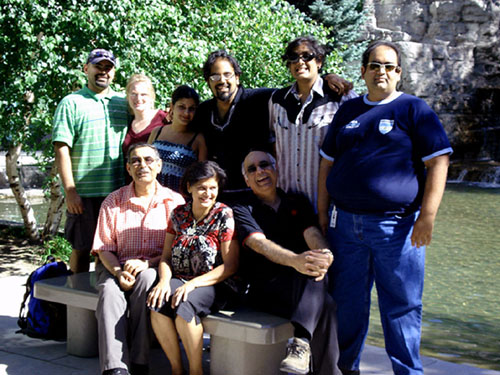
Our family at home in Toronto 2008

Our family at home in Toronto 2008
Amit, Heather, Fuzz, Aj, Jiv, Shiva, Rampa, Sero, Jai