Thursday, August 28, 2008

2012 election to be 'referendum' on political union: Manning

Prime Minister Patrick Manning still plans to rush his political and economic union with three OECS states union through Parliament and pass it by the end of the year. But Manning said Wednesday the 2012 general election will be a “referendum” for his initiative to establish political union.

The memorandum of understanding (MOU) Manning signed earlier this month with the leaders of Grenada, St. Lucia and St. Vincent will establish an economic union by 2011 and political union by 2013.

The "referendum" he is planning will only cover the political side of the union since the economic component would have been established one year before the next election is constitutionally due. He didn't include the economic part in his so-called referendum.

"If we consult the people in a general election and this is made an election matter, then if we win the elections we have the endorsement of the public...That’s how it works,” Manning told reporters.

He dismissed speculation that his initiative has been rejected by Jamaican Prime Minister Bruce Golding.

"We never sought any signatures from them and therefore there was never any question of being blanked," Manning added.

Golding issued a statement following his meeting with Manning that Jamaica would not participate in the initiative. He expressed concern about how it would impact the wider regional integration movement and suggested that it should be a matter to be discussed and debated by heads of government.

Manning said earlier this month that other states are welcome to join.

Commenting on Jamaica's position, Manning said it is not new, adding that he is "not worried at all” over the matter. And he said his unity initiative would have no negative impact on the regional movement.

Is Manning making Grenada a T&T colony?

A report in the Trinidad Express says former Grenadian Prime Minister Keith Mitchell offered Prime Minister Patrick Manning a proposal about a year ago to make his island a "virtual colony" of Trinidad and Tobago, with Grenada getting free access to the country's education, health and transportation systems among other benefits.

The offer was in a letter signed by Mitchell.

"The only thing that the letter didn't speak of having access to was the Trinidad and Tobago treasury. But, of course that was an unspoken word. But clearly we would have been in effect minding Grenada," the Express quoted one former minister as saying.

The report said certain cabinet ministers were of the opinion that Mitchell was trying to cut a deal for Trinidad and Tobago to pay its bills.

Now the same issue is on the table again.

Two weeks ago, Manning initialled a memorandum of understanding with the new Grenadian Prime Minister, Tillman Thomas, and the prime ministers of St Lucia and St Vincent for an economic union by 2011 and a political union two years later.

And Manning has been flying around the region, knocking on the doors of his regional counterparts to tell them about a deal that is still a big secret in Trinidad and Tobago.

At least two prime ministers - Bruce Golding of Jamaica and Dean Barrow of Belize - have told Manning they don't like the union idea.

But outside of that MOU involving Trinidad and Tobago and the three OECS states, Manning signed bilateral deals with Thomas during the Grenadian leader's recent two-day visit to Port of Spain.

Manning went out of his way to be cozy with Thomas, the man who had dethroned Manning's friend, Keith Mitchell, in a general election in July. Manning had openly supported Mitchell and went as far as suggesting that Thomas had planned a coup against Mitchell.

Manning sent a private jet for Thomas, who was more than eager to say there was no bad blood between him and his host. The $400,000 plane fare was not the only thing Thomas got during his 48 hours in Trinidad.

In two separate MOU's with Thomas Manning agreed to many of the things Mitchell wanted. Scholarships for Grenadians and access to Trinidad and Tobago's health care system to Grenadians, to name two.

Shortly after Thomas went home Manning flew to Grenada, picked up Thomas and made a lightning one-day visit to three OECS states to sell the union matter. The trip also gave the two leaders an opportunity to discuss other matters of "mutual concern."

Then Grenada's finance minister announced that the country was broke. Nazim Burke said there was no money to pay civil servants and finance government operations. The treasury was bare like mother Hubbard's cupboard and the island would have to go cap in hand for overdraft facilities to pay its way.

Neither Burke nor Thomas has said who will provide the funds for a bail out and under what terms. Which leaves the question about whether Manning and the Trinidad and Tobago taxpayers would be the benefactors.

Burke did say he has been talking with the International Monetary Fund (IMF), which is an international agency with very strict and binding rules. Few governments that want to stay in office court the IMF.

So are Manning and Thomas are now singing from the same song sheet that Mitchell wrote, offering to pawn Grenada and the future of all Grenadians to Manning for "a few pieces of silver"?

And it raises questions too about what really is in that larger MOU with T&T, Grenada, St Lucia and St Vincent that Manning is hastily trying to ram through the Parliament.

Government has an obligation to make sure the people of Trinidad and Tobago see that document in its entirety so there can be a public debate, not just the rushed limited exposure in the legislature where it will pass with Manning's majority regardless of what the opposition says or thinks. And it will pass in the senate too because of the government's majority there as well.

The opposition has an obligation to demand that there is full disclosure and that the people of Trinidad and Tobago get a clear picture about what we are getting into and why.

What is it that these countries have to offer than others don't have? And why the great rush?

Manning is on record as saying that the majority of people in T&T are behind him on this, but that comment within days of signing the MOU and without the public seeing the document raises the question about the basis on which Manning is making such a judgment.

Now he is embarking on a public information exercise, which is essentially a marketing drive to sell a product that people have not seen, hoping that the fancy public relations would trap the citizens into buying "cat in bag".

Trinidad and Tobago is still a democracy. And the politicians and the media have an obligation to the citizens to do everything they can to preserve and protect it.

Political and economic union might be a good thing. But it could also bad for Trinidad and Tobago. The people have a right to know the facts so they could weight them and decide.

Saturday, August 23, 2008

A letter from Jack Warner, MP, Chaguanas West

In his post Cabinet media conference last Thursday, Minister of Sport and Youth Affairs Gary Hunt was reported to have said that Trinidad and Tobago could learn from Jamaica in its own quest for sporting superiority and success.

The Minister was quoted as saying, "clearly they are doing something right and we can learn from our neighbours. We intend to collaborate on this matter closely."

The Minister in a self-serving stroke geared towards taking undue credit, was also quoted as saying that the sterling performance of our athletes at the Beijing Games was as a direct result of the programmes initiated by his Government.

For such an unabashed, unashamed, brazen and opportunistic statement, Minister Hunt certainly deserves gold for political indecency.

Minister Hunt’s brashness is a direct result of his unfamiliarity and ignorance of the sporting programmes and policies indoctrinated in Jamaica for the past fifteen years.

Minister Hunt is completely unaware that for the last three years the Jamaican Government has financed its football team to the tune of 100,000 USD per month and has covered all costs for housing, training and allowances to its footballers.

Minister Hunt is unconscious to the fact that the Jamaican Government has for the last ten years, funded in full all practice matches for its footballers to retain a spot in the game’s foremost competition.

Minister Hunt sits in political comatose, oblivious to the fact that Jamaica has a continuous National Sports Policy (and that Trinidad &Tobago has none) which is not subject to arbitrary modification when Governments change or when one Sports Minister succeeds another.

Minister Hunt simply does not know that Jamaica values its sporting programme as a means of combating the societal evils of crime and unemployment.

He is insensitive to the fact that in 1998 when the “Reggae Boyz” took to the world stage, PM PJ Patterson said publicly that for the year crime was reduced by 30% and that this was due solely to Jamaica qualifying for the 1998 World Cup in France.

This PNM Government are experts in “joining the bandwagon” for political mileage. The euphoria of victory brings all sorts of promises that never materialize.

The nation would never forget four years ago when they hopped unto the George Bovell bus and pledged an “Olympic” swimming pool. But when the fireworks of Bovell’s success had dwindled, the assurance of that swimming pool drowned and died a PNM inflicted death.
Our national footballers and cricketers too, have suffered the effects of maladministration in sports by the uncaring PNM.

Minister Hunt now takes credit for our athletes in Beijing and the circumstantial fact that their success comes during his government’s watch.

Utilizing such logic, then the fact that Trinidad &Tobago sits in the top ten in the global homicidal index, has climbed up the world poverty list and competes for gold in the corruption index are all benefits attained under PNM rule.

The nation has now been promised a sports master plan by 2016. Wishful thinking from the Minister whose myopia seems to extend beyond his knowledge of sports and into politics, for by then his Government would have been rejected by an already dispirited nation.

Jack Warner | Member of Parliament Chaguanas West.

Big welcome for T&T Olympics "silver" stars

The government of Trinidad and Tobago and the opposition finally share something - the pride in the national four-member sprint team at the Beijing Olympics that won the silver medal in Friday's 4x100 metres relay final at the Games.

In a statement, the Government praised the sprint quartet for achieving the historic Olympic milestone.

The team of Emmanuel Callender, Keston Bledman, Richard Thompson (who also won silver in the 100 metre sprint) and Marc Burns completed the relay in a time of 38.06, just second behind the Jamaicans who won the gold medal.

“These fine athletes will be icons for the people of Trinidad and Tobago and have shown them what they can accomplish with their lives,” the Government stated.

The statement also paid tribute to injured sprinters Aaron Armstrong and Darrel Brown who were unable to participate in the final. It said team’s second place gave the country its first medal in this event and was even more remarkable because “three of the four athletes (Thompson, Callender and Bledman) were participating in their first Olympic Games.”

Government said they will get “a fitting welcome” along with the full national team including men’s 50 metres semi-finalist George Bovell III. Bovell didn't win a medal in Bejing but brought home a bronze medal from the Athens Games in 2004. Government is also considering a "fitting" reward for Thompson.

Opposition Leader Basdeo Panday said he was “extremely happy”, calling it a historic moment . He said the Caribbean's showing in Beijing was "undoubtedly one of the best in terms of the performance by Caribbean athletes, most notably the Jamaicans."

Panday said Government must build upon the successes of these athletes by ensuring that they have proper facilities to train and develop their skills.

Trinidad and Tobago's other moment of "Olympic glory" was in 1976 when Hasely "Raj Paul" Crawford won the gold medal in the 100 metres sprint at the Montreal Games. Crawford was the only T&T citizen to compete in four Olympic Games.


Trinidad and Tobago honoured Crawford by naming a new DC-9 jet after him and naming a stadium in his honour. In 1978 he was awarded the Trinity Cross, the nation's highest honour.
In 2000 he became the Trinidad and Tobago Athlete of the Millennium.

Obama chooses Joe Biden as VP

Barack Obama has chosen veteran Delaware Sen. Joseph Biden as his running mater for the November 4 presidential election. Biden has been a leading voice on international affairs and analysts say he would bring not only foreign policy expertise to the ticket but strong working-class roots.

Obama's opponent, Republican John McCain, has sharply criticized the young Illinois senator for his lack of foreign policy experience.

Read more about Senator Biden


But the choice of Biden is likely to deal with what might have been an achilles heel in the Obama campaign.

Biden is a Roman Catholic who has served since 1972. He is known as a strong orator and chairs the Foreign Relations Committee, something analysts say would balance Mr Obama's self-confessed lack of foreign policy experience.

The son of a car salesman, he is also expected to appeal to the blue collar workers with whom Obama has so far struggled to connect.

The senator ran against Obama and Hillary Clinton for the presidential nomination but dropped out after failing to gain enough support.

The Delaware senator emerged as a strong possibility after three other contenders - Indiana Senator Evan Bayh, Virginia Governor Tim Kaine and New York Senator Hillary Clinton reportedly were bypassed for the job.

Others who were on Obama's shortlist were Kansas Governor Kathleen Sebelius, New Mexico Governor Bill Richardson and Texas Representative Chet Edwards., a leading voice on international affairs.

The McCain camp's immediate reaction was that the choice of Biden is an admission that Barack Obama is not ready to be president.

"Biden has denounced Barack Obama's poor foreign policy judgement and has strongly argued in his own words what Americans are quickly realising - that Barack Obama is not ready to be president," McCain campaign spokesman Ben Porritt said in a statement.

Visit the Obama website

Manning shows contempt for citizens, T&T sovereignty: Warner

Chaguanas West MP Jack Warner has sharply criticized Prime Minister Patrick Manning for his regional integration plan. In a formal statement, the MP called it "an unprecedented stroke of political deflection."

"Manning's ‘coalition of the willing' is but a mere attempt to divert public attention from bolting crime, runaway inflation and the crawling commission of enquiry into UDeCOTT," he said.

"His clandestine signing of the MOU (Memorandum of Understanding) which no one has had the benefit of seeing, except those who hastily agreed to do so, begs of surreptitious and covert motives," he said.

"His inconsistent and paradoxical approach towards consensus and national approval and his flippant dismissal that political integration shall not be subject to a referendum is typical of one who is on a ferocious quest for executive control."

On August 14, Manning and the Prime Ministers of St Vincent and the Grenadines, St Lucia and Grenada signed the MOU to establish economic union by 2011 and political union two years later.

Manning has said Dominica, Antigua and Barbuda and St Kitts are also expected to sign the MOU, which he said is aimed at strengthening the integration process.

But Warner is concerned that Manning believes something as fundamental as this would merely require a simple majority for passage in the House of Representatives.

"The attempt to utilize perceived loopholes in the Constitution is one that is flawed and unsound in law and one that the Parliamentary Opposition will fully expose at the appropriate debate," Warner promised.

"...clearly any attempt at political union poses constitutional questions for...the future independence, role and responsibility for the office of the President, the service commissions, the composition of Parliament, powers to investigate outside the jurisdiction by the DPP and Ombudsman and appeals to the Judicial Committee of the Privy council," Warner pointed out.

He said Manning's political integration is "clearly a case of ambition surpassing the rule of law and constitutional imperatives."

The Chaguanas West MP said Manning's "flip-flop approach and his public relations approach to consultation" are discourteous to the people of the country and a "politically discourteous act to the integrity of our brothers and sisters in the Caribbean and the historical motives of CARICOM."

Warner said on the eve of the 46th anniversary of the country's independence Manning is making a "mockery of our sovereignty", which he said the PNM government treats with contempt.

Friday, August 22, 2008

Who was Vernon Paul? And what about his conspiracy story?

A Trinidadian man named Vernon Paul died recently in a fiery crash in Caracas, Venezuela. Another accident, another traffic fatality. But this victim was not just another statistic. His name was Vernon Paul, the man who fingered top PNMites in a conspiracy to discredit Sadiq Baksh. And his finger pointed to the highest levels in the country's political directorate.

Paul grew up in Dow Village, South Oropouche, and claimed that he worked for an elite unit within the U.S. Drug Enforcement Agency (DEA) handling anti-drug assignments all over Latin America.

He also claimed that he was the man who recaptured notorious drug dealer Deochand Ramdhanie in Tucupita, Venezuela in 1998.

But the story that put him on the front page broke in January 2006 when he claimed that top PNM members conspired at the highest levels to frame Sadiq Baksh in 2002 and implicate him in a drug and terrorism plot.

In 2002 Baksh was MP for San Fernando West and the party organizer for the United National Congress (UNC).

Baksh was seen as the man largely responsible for the UNC winning a majority in the 2000 election and was perceived as a threat to the PNM.

President Robinson, following the 18-18 tie in the 2001 election, had also just appointed Patrick Manning prime minister.

Manning was unable to name a Speaker and convene Parliament and was desperate to find a way to stay in office without calling another election.

The opposition was a thorn on Manning's side, demanding an election and Team Unity, led by Ramesh Lawrence Maharaj was showing signs of planning to sit out the 2002 election whenever it was called.

It was the breakup that created Team Unity that caused the fall of the Panday government in 2001 and the subsequent 18-18 tie that allowed Manning to make a back-door entrance to Whitehall.

If Team Unity were no longer going to be a spoiler, then any new election would be a straight fight between the PNM and the UNC.

In the 2001 election the UNC had more votes and the higher popular vote and would have won back its majority if Team Unity had not taken a handful of critical votes in Tunapuna.

That was the background to the alleged plot that Paul revealed in a letter to the Commissioner of Police, Trevor Paul.

It was July 2002. Sadiq Baksh and his wife, Champa, were out of the country when his parliamentary colleague and MP for Caroni East, Ganga Singh, discovered what he said was a PNM plot to smear Baksh.

At a hastily convened news conference at the UNC Rienzi Complex headquarters, Singh told the media that he was tipped off by an informant, whom he did not identify, about a conspiracy involving "top men" in the PNM. He also did not name the alleged conspirators.

The plan, he said, was to frame Baksh by placing explosive devices and pure cocaine in a water tank at Baksh's home in San Fernando, then raid the premises, find the illicit material and charge Baksh.

According to Singh, that would have put Baksh out of the picture and reduced the balance in the Parliament by one to give Manning a simple majority.

The reaction was predictable. Each camp cried foul. UNC supporters blamed the PNM; PNM supporters called it a ridiculous story with no merit. The PNM even said it was hatched by the UNC to create the impression that the PNM was involved in a plot, pointing out that people should ask Singh how he knew so much about a plan that was allegedly a top secret operation.

Whoever planted the "evidence" in the water tank lost out; Baksh's son found the cocaine and explosives and called the police. The table was turned. Instead of Baksh being charged with an offence police had to launch an investigation to find out who put the stuff in his water tank.

In Parliament it was business as usual but Manning was running out of time. He had already asked the president to prorogue the Parliament twice and he could hold on no longer. So he pulled the plug and called an election, which he won.

That was 2002. Manning was now fully in charge with a clear majority and it seemed the story went away.

Then, four years later in 2006 Paul surfaced with what appeared to be a truly incredible conspiracy story. And what a story!

Read the full story as reported in the Sunday Guardian


He sent a report to Police Commissioner Trevor Paul accusing three officials in the Manning government of plotting to frame Baksh and Singh.

The commissioner confirmed that investigators had tried to get to the root of the allegation and that police would interview the three government officials. Paul's finger also pointed to a Muslimeen connection and the police chief also confirmed that investigators would question that person.

Commissioner Paul did not reveal names. The Trinidad Guardian reported that it had learned that among those to be interviewed by investigators were a senator, an MP, a top PNM official and an ex-senior member of the Jamaat al Muslimeen.

In an exclusive interview in Venezuela, where he was living in "exile", Vernon Paul gave details of how the four men plotted with at least two Venezuelans to frame Baksh and Singh.
"The ex-DEA associate claimed that the intent of the plot was to help destabilize the UNC in the 2002 general election and that the plan was hatched at the homes of two PNM officials," the Guardian reported.

Read the Guardian story


The Police Commissioner revealed that in December 2005 Vernon Paul contacted the Ministry of National Security and spoke with an official who then called the commissioner.

"He said the ex-DEA associate told him he had information on the five kilos of cocaine and two missiles which were found in Baksh’s water tanks in 2002. Paul said he arranged for two local officers to meet Vernon Paul on December 14, in Venezuela, but that meeting was shelved because of travel arrangements," the Guardian reported.

The paper said seven days later, on December 21, two officers went to Venezuela and met with Vernon Paul at the Marriott Hotel in Caracas, who had offered to give a statement and name those who participated in the plot.

The commissioner said Vernon Paul refused to give a statement, fearing for his safety. But Paul talked with the Guardian and corroborated the meeting at the Marriott Hotel, his contact with commissioner Paul and his refusal to sign any statement in fear of his safety.

The police commissioner said he later received a package that contained two statements, adding that they did not have any signatures. He said the allegations against the three government officials were contained in those statements, but because there was no signature he had to check the authenticity of the documents.

But Vernon Paul denied that and in speaking with the Guardian he was adamant that he had forwarded notarized statements bearing his signature, as well as fingerprints to the commissioner, and they were delivered to the commissioner on January 17.

The TnT Mirror went further that the Guardian and named names of the top PNM members mentioned in Paul's statement as well as the Muslimeen connection.

Read the TnT Mirror story

The PNM mounted a campaign to discredit Vernon Paul. And a statement by Information Advisor at the American Embassy in Port of Spain, Robert Skinner said that Paul "has never been an employee of the U.S. Government".

However, a senior embassy official has said that Skinner was not authorized to make any such statement, because it is not the policy of the U.S. government to identify individuals who work as undercover agents or informants.

Baksh has demanded an investigation to clear his name. But it appears the probe did not go beyond the hype and the headlines.

Read the story: Baksh wants probe


The media lost interest and the opposition, which was fighting its own internal battles at the time, didn't bother to keep the story on the front burner.

The Manning government remained in power for its full term, called a general election and won a strong majority.

As for the conspiracy story, well you might say it just went up in flames because dead men can't talk.

Tuesday, August 19, 2008

Trinidad woman jailed in NY for 21 years for killing husband

A judge in New York on Monday jailed a 29-year-old Trinidadian woman for 21 years for killing her husband. Kelly Chadee-Forbes told the judge she killed her spouse, Michael Forbes, 50, in self-defence, but the judge didn't accept her defence.

“Nothing I can do today will bring Mr Forbes back. But I can assure them that for the next 21 years, you will be paying for your actions,” the judge said.

Michael Forbes, who worked in real estate in Brooklyn, married Kelly in September 2007 after knowing each other for about a year.

Two months later on Nov. 21, 2007 police responded to a call from the couple's home where they found Forbes unresponsive but alive. He died an hour later in hospital. Autopsy results show death was from asphyxiation.

The couple lived in a luxurious home, which featured an inground swimming pool and backed up to a waterway lined with private docks. Forbes' father bought the property for US$799,000.
Kelly Chadee-Forbes, who is from Arima, pleaded for mercy, which the judge didn't grant.

“My life in Trinidad was not easy. When I was 19 years old, I was kidnapped and assaulted at gunpoint. A few years later, I became pregnant with my beautiful daughter, Kadeshja. When I was 24, I was raped. Thereafter, I moved to the United States to live with my brothers. I thought my daughter would have a better life and more opportunity,” she told the court.

She said she met Forbes while working at a beauty salon.

“He pursued me with flowers, gifts and trips. He promised me and my daughter a better life. He said he wanted us to settle down and build a family together. I believed him,” she said.

However, according to Kelly, he become a changed person from the loving man who courted her.

“He began to abuse me emotionally, mentally and physically. He told me not to go to see my brothers, because he had enemies in Brooklyn.”

She described her husband as a heavy drinker and smoker and said she tried to get him to change his lifestyle. She told the court on the day he died the 250lb Forbes attacked her and tried to strangle her and she defended herself. It was the same story she told police and the media following her arrest.

News reports in New York about the murder indicated that she had bruises on her hand, which might have indicated a struggle had taken place. She said Forbes attacked her with an electrical cord.

“I survived by the grace of God and His mercy. He grabbed me and tried to put the cord around me...And I know in my heart that I am alive today because God gave me the strength to fight Michael off.”

Friday, August 15, 2008

Guest column: Manning's Reforms

IT IS BECOMING increasingly clear that Prime Minister Patrick Manning is on a journey to leave a legacy not only on the political landscape of Trinidad and Tobago but across CARICOM.

He is already known for toying with political constructs that seek to isolate sub-regions in CARICOM, such as the Manning Initiative, which, to this day, does not have a compelling purpose.

But the biggest of Manning's ideas has come in the form of a working paper – not yet government policy – that strives to improve the governance structure of Trinidad and Tobago, perhaps inspired by the 18-18 tie in the 2001 general election.

The proposed reforms of the constitution, however, do not indicate in any way how they would resolve such an occurrence in the future.

The essence of Manning's proposed reforms is to make the executive president the head of both the government and the state, giving what is now an all-powerful prime minister even greater powers of governance and control.

While upgrading the status of the prime minister, the proposed new draft constitution devastates the contribution of other elected members of the House of Representatives, both in terms of quantity and quality in the cabinet.

In fact, according to Manning: "It is proposed that the cabinet would now AID AND ADVISE [my emphasis] the president on the general direction and control of the government. It would comprise the president, vice-president and up to 25 members, of whom not more than six would be appointed from the House of Representatives and three from the Senate. The rest of the ministers would be appointed from outside of the parliament."

Imagine, a leader of a political party in Trinidad and Tobago uses 40 other party members to assist him in securing victory at the polls, but then agrees sufficiently with proposed reforms to bring them to parliament suggesting that at most – not at least – six ministers could be elected Members of Parliament.

On two scores, Prime Minister Manning's motives would have to be questioned: first, no other elected MP has to be a minister; and secondly, the number of ministers elected is restricted to six.

It takes a very special politician, guided by some higher power, to reduce other elected Members of Parliament – from whom he derived his power – to mere statistical objects.

It must be the case that only elected members of the House of Representatives can cast a secret ballot to determine who becomes the executive president.

Under the current constitution, the non-executive president is chosen by the Electoral College, a unicameral body consisting of all of the members of the Senate and the House of Representatives, convened by the Speaker, as chairman, and who has an original vote.

It is particularly striking that only the president and the vice-president are guaranteed membership of Manning's proposed cabinet, which has an upper limit of 25 members.

Since the president and vice-president are to be appointed from the House of Representatives, only four other members from the ruling party can become ministers. That makes the proposals even more ludicrous!

Political folly

At the two extremes, ministers appointed from outside of the parliament may make up – at most – 23 out of the possible 25 members of the cabinet, or – at least – 16 out of the possible 25 members.

These ministers would be all appointed by the president who got his power from the elected members of the House of Representatives!

In its current state, the governing party in Trinidad and Tobago must have at least 21 members in the Lower House who, under the proposed reforms, would be restricted to offering only "aid and advice" to the cabinet on the general direction and control of the government – a restriction that is also imposed on the cabinet.

To me, that is political folly in the extreme.

The only reasonable proposal that prevents the new draft constitution from being seen as the making of an elected dictatorship is one for a term limit for the executive president, a maximum of two terms – ten years at most.

Otherwise, the Manning proposals smack of a leader trying to secure ultimate political power, more in search of creating a one-man show than entrenching a participatory democracy that broadens the base of leadership.

Having proposed to emasculate the elected representatives in the Lower House, Manning also wants to see an enlarged and essentially elected Senate for Trinidad and Tobago.

The following proposed reforms may help to restore a sense of balance with respect to those who voted for having some say in the general direction and control of government.

The Senate would comprise 49 – up from 31 – members of which 28 would be elected, and based on recommendations from the political parties following a general election, 18 would be assigned seats on the basis of proportional representation.

The other three senators would be elected by the Tobago House of Assembly.
More questions than answers

The existing nine Independent senators would be no more; yet, it appears that the broad principle – apart from the President becoming more powerful - is to involve more non-political practitioners in the decision-making process.

This identifies a basic inconsistency in the proposed reforms.

Oddly enough, the Cabinet, which has the responsibility only to "aid and advise" the President on the general direction and control of government, would be the least democratic of the institutions of government.

It is widely believed that people who get involved in elective politics do so out of self-interest, and so, it is going to be more than interesting to witness a national debate in Trinidad and Tobago on a proposed constitution that reduces the effective participation of the majority of elected Members of Parliament in running the affairs of government.

Prime Minister Manning is unorthodox, but his desire to change Trinidad and Tobago's constitution to increase the power of the political leader raises more questions than it provides answers.

It is being argued by some commentators that that increased power would come at the expense of the judiciary and the parliament – a frightening prospect for any country!

But perhaps the most frightening aspect of this proposed mischief would be the decimation of the will of the people in the first-past-the-post system used to elect members to the House of Representatives that would have to give way to the will of a political leader, especially in determining the composition of the Cabinet, a body of ministers who traditionally initiate policy and are collectively responsible for the government of the country.

For the sake of the people of the people of Trinidad and Tobago, may it never happen.
The rest of us in the region, especially here in Barbados, should watch the developments closely, because politicians are . . . well, politicians.

Column by ALBERT BRANDFORD, Political Correspondent, The NATION, Barbados reprinted with permission of the writer. Email: albertbrandford@nationnews.com

Thursday, August 14, 2008

Big gas find off T&T won't satisfy demand: Expert

A Canadian energy company operating in Trinidad and Tobago on Wednesday announced a “significant” gas discovery in one of its offshore drilling platforms. It’s the second major discovery this year by Superior Energy Inc and its partners in the “Bounty” exploration well located in the “Intrepid” Block 5(c) approximately 60 miles off the east coast of Trinidad.

The news pushed up shares in the Calgary-based energy company by 19 per cent on the Toronto Stock Exchange.

Chairman Greg Noval said, “We are very pleased with the results of the ‘Bounty’ well and production testing indicates that we have drilled one of the best natural gas wells offshore Trinidad.”

The company said in a statement that initial test results indicate that the “Bounty” well is capable of producing “at a rate of approximately 200 million metric cubic feet per day (mmcf/d) from this high pressure zone.”

It said the results from the “Bounty” well and “interpretations of extensive 3-D seismic data and other data indicate a natural gas resource potential of up to 2.6 trillion cubic feet (TCF) of natural gas from the tested structure.”

Superior Energy said the gas find presents “tremendous opportunities…in the oil and gas industry in Trinidad and Tobago.”

That would be good news for Trinidad and Tobago if all the factors point to a reliable long-term supply to fuel much of the emerging energy-based enterprises in the country.

But one expert has told Jyoti Communication that gas supplies are not going to last as long as officials estimate.

At a recent media briefing to discuss the findings of the Ryder Scott report for the year ending December 2007 experts presented an upbeat and optimistic picture of the energy sector with respect to proven gas reserves.

Senior government minister Conrad Enill told the media he was very pleased with the data, noting, “We could not have expected a better result.”

The consensus from the experts was that the ratio of reserves to production means that the country can expect gas supplies to be constant and stable for the next 13 years.

That projection is based on proven reserves of 17 TCF (Trillion Cubic Feet), with a daily use of over 4.0 BCF (Billion Cubic Feet) per day. That works out to be annual natural gas usage of 1.46 TCF.

But the math doesn’t add up based on the official figures since 17 divided by 1.46 equals 11.6 years.

“This should not be taken to mean that there is any abundance of gas around relative to our consumption, and the reserves to production is certainly not 13,” the expert said noting that any gas or oil reservoir starts to decline long before it is exhausted.

“Hence long before the 11.6 years have passed, if we do not confirm more proven reserves, our gas fields will not be able to deliver the gas rate required by industries presently operational in Trinidad.”

He predicted that despite all the optimism, industries that depend on gas for survival would have to begin shutting down within six years unless truly significant new discoveries are made.

If the analysis is correct it means that existing industries cannot have the assurance of 20 years of future gas supply and newer ones like Essar Steel and Alutrint would be in the same predicament.

The analysis raises this fundamental question: if existing industries cannot have the assurance of 20 years of future gas supply, how can this government possibly sign up Essar Steel and Alutrint with this same assurance?

Does it mean the government plans to shut down other industries whose continued existence is not as "attractive" to government as the new kids on the block?

The expert believes that all the new finds from Superior Energy and Petro Canada won’t make much difference to the picture since they would amount to only one year’s supply based on the present consumption rate.

If new projects come on stream, they will add to the demand for gas and the 11.6 years estimates based on official figures would drop even lower.

New areas for exploration are in deep water where any discoveries will be very expensive to produce and have long lead times.

BPTT has cautioned that future discoveries are likely to be smaller, suggesting that the whole gas-based industrialization program could be in deep trouble in less than a decade. That would have a devastating effect on the national economy, which is largely dependent on the energy and industrial sectors.

Saturday, August 9, 2008

Robin Montano sues HUC boss

Attorney Robin Montano has sued Hindu Credit Union (HCU) Harry Harnarine for what Montano claims are defamatory statements made about him on a radio program. Monatno is also suing the HCU's communications subsidiary which operates the radio station, using a licence leased from a private company.

Montano's attorneys Anand Ramlogan and Cindy Bhagwandeen filed the writ Friday in the San Fernando High Court, claiming "aggravated/exemplary damages and costs".

The former Senator claims that on May 30 Shakti Radio broadcast a live program in which Harnarine allegedly made libellous statements about Montano.

Montano claims that the statements were made as part of a strategy by the defendants to create an impression that Montano had a vendetta against the credit union/Indians/Hindus.

Montano says the statements were aimed to boost the credibility of the credit union and Harnarine.

Montano said the context of Harinarine's words was defamatory and the "natural and ordinary meaning" of the words defamed him because they were made "with the intent to scandalise and embarrass" him.

Montano is claiming that his character had been seriously injured and he had suffered discredit to his reputation in his professional life, indignity, loss and damages.

Thursday, August 7, 2008

Duprey says HCU was involved in "risky" business

Business magnate Lawrence Duprey says he abandoned a $200 million deal to help the Hindu Credit Union (HCU) because it was too risky. He said he was unable to see any way to stop the financial crisis.

In an interview with the Trinidad Express Duprey acknowledged that HCU President Harry Harinarine had raised the profile of the organization, taking it from a small obscure credit union to a financial powerhouse with more than 186,000 members and $1.1 billion in assets.

When Harinarine took charge of the HCU in 1997 there were only 400 members and the assets were $5 million.

Harinarine developed an aggressive business plan for the HCU while he continued to work for Duprey's insurance company, CLICO.

Harinarine's trouble began as far back as 2004 when there was a run on the financial organization. He says it was because of negative publicity indicating that his business was heading into stormy waters. It was after that crisis that the CL Financial group discussed a business proposal with HCU.

Duprey said former CLICO chief executive Claudius Dacon approached him with a proposal to bail out the HCU.

The CL Financial chief said he wanted to help because "The Hindu community represents many of our biggest customers...We wanted to help the depositors."

A deal was signed on May 3, 2005 but Duprey said it soon became clear that it would not work.

"We looked at the transactions and we didn't see a way to stop the leakage. Every time we plugged a hole, another ten opened up...We knew people were going to lose their money."

The Express said minutes of a meeting between Duprey, Dacon and Harnarine on March 3, 2005, detailed matters discussed to identify a way forward for the deal. They included:

  • purchase of property at Freeport, known as Savitur, for $34 million
  • securisation of various HCU properties for $43 million
  • confirmation of sales to Clico of properties at Chadee Lowhar Trace, Cunupia, and 253 acres of land at Penal Rock Road
  • the sale of the mortgage portfolio in the amount of $30 million to Colonial Life Society Building &Loan Ltd
  • sale of two-thirds of HCU subsidiary HCU Money Express and the sum of $100 million to be invested in the HCU Financial Group

Harnarine claimed that the deal soured because CLICO only offered $160 million in insurance premiums to members, not the $200 million promised.

He told the Express Duprey apparently didn't know about the transaction because in 2005, the HCU was comfortable paying off depositors.

"At no time was the deal to plug any hole," he told the Express. Harnarine said the plan was for a strategic alliance between the two organizations. He said Duprey should have reexamined the deal.

He said the initial valuations on HCU properties were flawed and had to be redone. And he noted that CL Financial did benefit from the deal since it acquired several properties in Central Trinidad that belonged to the HCU.

Tuesday, August 5, 2008

Liquidator in charge of HCU, not Harry Harinarine

The court-appointed provisional liquidator looking after the affairs of the Hindu Credit Union on Monday denied that he has asked HCU president Harry Harnarine to resume control of the HCU group of companies.

Harinarine told a meeting of depositors and shareholder last Friday that the provisional liquidator had asked him to take back control of the group of companies. But he said he was waiting to clarify certain matters before making such a move.

Harnarine told the meeting the HCU group is a separate entity from the HCU Credit Union Cooperative Society.

But liquidator Ramdath Dave Rampersad denies that and has been running ads on two radio stations making it clear that he didn't ask Harinarine to resume control of the HCU group.

Rampersad issued a statement to depositors of the HCU and the public “that they should view with scepticism any statement or release concerning the HCU unless made by or with the authority of the provisional liquidator.”

He said the inaccurate claim by Harnarine "may result in the undesirable and inaccurate public perception that certain persons have or continue to have a role in the management of the HCU together with the provisional liquidator."

Rampersad said he is managing the HCU with help from persons “expressly authorised by him.”

The statement said that under the terms of the High Court order dated July 23, 2008, Rampersad is required to take over and manage the affairs of the HCU to the extent necessary to maintain the value of its assets.

Rampersad assured HCU depositors and shareholder that none of the HCU’s assets has been liquidated. He said the court order does not require or permit him to liquidate any of the credit union’s assets.

Read related story: HCU doesn't have protection of CU stabilization fund

HCU doesn't have protection of CU stabilization fund

The President of the Credit Union Stabilization Fund says the Hindu Credit Union (HCU) was not a member of the fund and its members, shareholders and depositors do not have the protection for their investment that the fund offers.

Dr Anthony Elias told the media only 38 of the 120 credit unions in Trinidad and Tobago have joined so far, noting that some of the country's big credit unions are not members of the fund.

“As per the guarantee offered to credit unions, the stabilisation fund provides coverage to individual shareholders of credit unions who are members of the fund up to a maximum of $50,000 in shares and a maximum of $50,000 in deposits,” Elias said.

That means that had the HCU been a member many of its clientele would have nothing to worry about since their investments and savings would have been secure.

As an example of how credit unions benefit from the fund, Elias noted that the fund would pay members and shareholders of the Neal and Massy South Credit Union Cooperative Society Limited, which was placed into liquidation by the Commissioner of Co-operative Development in November 2007.

He said shareholders of that credit union may get back as much as $100,000 each from the fund and that they would get the money before the end of the year.

He said each shareholder of the Neal and Massy South Credit Union would receive 100 per cent of the value of their shares in the credit union and 100 per cent of their deposits up to the maximum of $50,000.

Elias said the rules don not make it mandatory for credit unions to join the nine-year-old organization.

Any registered credit union can join by submitting an application and a financial report for the most recent three year period to ensure that the credit union is viable.

He explained that member credit unions must buy one $100 share in the fund and pay a premium of one per cent of their shares and deposit at that point.

The fund continuously monitors its members and offers technical assistance to member credit unions which are experiencing difficulty in meeting prudential standards, he said.

Saturday, August 2, 2008

Why does T&T need a new form of indentureship?

It is an interesting coincidence that on the day the nation took a holiday to commemorate Emancipation Day we were hearing about the possibility of Indians being encouraged to leave their homeland and come to Trinidad and Tobago to develop the country’s ‘mega-farms'.

A report in the Times of India alerted the local media to the story, which was confirmed by the Indian High Commissioner to Trinidad and Tobago, Jagjit Singh Sapra, who pointed out that there is no firm proposal yet.

But it might. And that’s why this story is worth noting.

At first glance it seems like a good idea since Indians are an agrarian people. They created India’s green revolution and they rescued the dying plantation economy in Trinidad in the post-emancipation period. So perhaps they can do it again.

But times have changed.

The Indians who saved agriculture in the 19th century remained in Trinidad and made the British colony their home. And their descendants have gone on to keep agriculture alive for more than 150 years.

The nation has an able and willing agricultural work force, so why does the Manning administration want to bring Indians to Trinidad and Tobago to run mega farms?

In the 19th century after Britain set the slaves free the plantations suffered a dramatic decline because of the absence of a reliable source of cheap, effective labour.

Slaves refused to work for their former masters for good reason – the plantations symbolized degradation, abuse and servitude. Slavery lacked any measure of humanity and was the worst injustice “civilized” society inflicted on fellow humans. And indentureship was no better.

In fact, according to Lord John Russell, British Secretary of State for the West Indian colonies, indentureship was “a new system of slavery.” He was not exaggerating the issue.

Indians were treated like leased animals, herded into plantations and jailed if they strayed from their designated places of work. They were abused, flogged and treated as new slaves. Many were murdered.

Their children were denied an education. This is how one planter justified it to a committee of the Legislative Council:

“This is an agricultural country. Unless you put their (Indian) children to working in the field when they are very young, you will never get them to do so later. If you train them to work in the fields you’ll never have any difficulty…if you decide to educate the whole mass (of Indians)…you will be deliberately ruining the country.”

It took the efforts of Canadian Missionary Dr John Morton to free the children from forced bondage by setting up Canadian Mission Indian schools alongside Presbyterian churches.

That was the beginning of the upward mobility of the Indians and their first step to move from the periphery to the centre of society.

This digression in history is important.

In the 19th century Indian labour brought the plantations out of decline and Indians remained close to the land for generations. And their commitment to agriculture is what has kept the markets supplied. And it continues today.

So going back to India might give agriculture the boost it needs, but why go to India when you have a strong agriculture-based work force in the country today clamouring for farmland so they could feed themselves and their families?

What about the mass of Indians who are citizens of Trinidad and Tobago who have spent their lives feeding the nation? Why can’t they run the mega farms and develop agriculture? Why can’t the government give local Indian businessmen leases to land under the same terms that would be offered to Indians from India?

The answer is this: it’s bad for Manning’s politics.

He closed the sugar industry and put 10,000 families on the breadline, calling it the best decision he ever made.

That was a political decision aimed at destroying the opposition base. It’s been more than six years since he promised the former sugar workers small farms to develop agriculture as part of their severance agreement. In spite of a court ruling ordering the Government to hand out the farms the former Caroni workers are still waiting.

Yet we keep hearing about the need to develop agriculture. We hear about investing in Guyana; we hear the Cubans are coming. And now the Indians might be coming.

For generations the local farming community, dominated by descendants of the Indentured Indians, has suffered neglect from every government of Trinidad and Tobago.

Manning cannot give the farms to locals because he might offend his “constituency” while strengthening a voting block that has traditionally supported the opposition. He fears that former sugar workers might become a powerful army of agriculturalists and vote him out of office.

He cannot take that risk.

He told me in 1999 – and has said the same thing publicly – that his greatest mistake in his first administration (1991-1995) was that he didn’t take care of his people.

When I asked him what he meant he explained that “his people” were those who had been loyal to him and his party, not necessarily people of any one ethnic group. It amounts to the same thing.

He is determined to take care his “tribe”, which comprises people from the two founding groups. Political tribalism is not race-based but built on blind loyalty. That’s the constituency Manning can’t offend. They might pull back their support for him.

So he cannot and would not employ the ready, willing and able agricultural work force to create his mega farms. Instead he must keep them down. It’s a matter of political expediency. They are not from his “tribe”.

Manning has done everything to frustrate efforts of the farming community, including the mass of sugar workers who lost their jobs in his first strategic move after taking office following the 2002 general election.

And in the 2007 general election while the opposition campaigned to re-open the sugar industry as the base for a major agro-Industrial thrust, Manning said the industry would only be revived “over my dead body”.

He justified it by saying that the sugar industry would keep the children of sugar workers in servitude, that his vision is for them to move out of the agricultural sector and improve their lives.

Where does Manning live?

The Indians who slaved on the plantations worked hard to free their children from that scourge. Their children and children's children are the judges, lawyers, doctors, teachers, engineers, farmers and fishermen; they are the leaders and role models in every facet of national life.

They did it while their parents lived off the land, feeding them and the nation.

Perhaps somebody needs to tell Manning that Basdeo Panday, Noor Hassanali and Satnarine Sharma are products of the sugar and agriculture.

Manning's false notion that the plantations would condemn the children to “slavery” is bogus and dishonest.

In fact when he closed the sugar industry he was working hard at creating a community of dispossessed people. He was robbing them of their self-respect, their independence and their pride. And that is why he will not give them the land that is rightfully theirs.

And now he talks about importing Indians to do the same thing that nationals can do and are willing to do. It’s hypocrisy!

He’s doing it because expatriate Indians are not rooted in the community; they don’t have political allegiances and they are transients. They would have to live according to contractual rules and go home when they are no longer needed.

Why do you need a foreign work force and entrepreneurship class when you have them at home? It sounds like indentureship all over again. And it feels like history is repeating itself – first the Chinese, now the Indians.

Here are some questions that people must ask:

  • Will Manning import individuals or families?
  • Where are they going to live?
  • Will their children go to school or be condemned to live like those who arrived in Trinidad under indentureship?
  • How would you deal with the language barrier?
  • What happens to them when they have toiled and created a vibrant agricultural sector?
  • Who will inherit the farms they would build and nurture?

Manning probably knows the answer to all these already but he’s not going to tell you.

Perhaps you could look to Zimbabwe and Robert Mugabe for some of the answers.

When Mugabe took charge as a populist former freedom fighter, he inherited a nation that was the breadbasket of the region. He allowed the white farmers to develop their holdings and create food stability.

Then he moved against them. He took their farms and handed them to his supporters, “his people”.

His shortsighted political strategy destroyed agriculture and the economy. Today Zimbabweans are starving; eight in every 10 people have no work. The economy has collapsed and inflation at more than one million per cent is the highest in the world.

I am often puzzled by the complacency of the citizens of Trinidad and Tobago and the silence of the politicians and other primary definers of society on critical national issues such as this one. But perhaps I am wrong. Or maybe "we like it so".

Jai Parasram | Toronto, Canada, Aug 02, 2008

Cudjoe warns T&T PM about giving lands to Indians

Prime Minister Patrick Manning should not take the vote of Africans for granted. That warning has been sounded by Prof. Selwyn Cudjoe, Head of the National Association for the Empowerment of African People (NEAP).

Cudjoe was speaking at an Emancipation Day celebration at the Centre for Excellence in Trinidad.

The outspoken academic said while he supports the Manning Government "very strongly and very dearly" the People's National Movement should not "take the African voters for granted. "

He advised Manning to "deal with all of the problems of all Trinbagonians but do not forget our special needs."

And he was also critical of a report that the government is courting Indians to come to Trinidad to help develop mega farms on state lands.

"Any Government that takes it upon itself to transfer land unilaterally from one group to another threatens the stability of the society."

He declared, "A people without land are an endangered people. It could only lead to another form of enslavement."

Manning told the gathering because there is so much diversity in Trinidad and Tobago leaders must be very careful in the positions they take.

HCU shareholders, despositors might get $0.72 to the dollar

Harry Harinarine told the HCU Depositors and Creditors Group (HCUDSG) Friday lawyers for the liquidator for the HCU group have asked him to retake control of the HCU group of companies. And auditors says assets are valued less that originally estimated.

He spoke at a meeting of the newly-formed group at Gaston Courts, Lange Park, Chaguanas.

Harnarine explained that the ex parte injunction tha closed the HCU gave the liquidator control only of the HCU Credit Union Society and not HCU Financial, which he said is a separate entity.

This has been confirmed by D.Rampersad who explained that his company is required to continue as provisional liquidator pending the completion by the audit by Ernst and Young.

He said he has to appear before the High Court judge on August 11 at which time Justice Nolan Bereaux might end his assignment.

Harnarine said he is waiting for the judge to decide that matter first and that he wanted a reassessment of the assets of HCU Financial before taking back control. He said his lawyers will meet with the provisional liquidator and his lawyers on Monday.

A preliminary report by the auditors, which was completed last month, has estimated the HCU assets at $545 million, not the $817 million that the organization has said is the value of its holdings.

The liabilities exceed that and stand at $716 million. Based on that Ernst and Young estimates that at best, a depositor can expect 72 cents on the dollar.

That means an investment of $1,000 would return only $720 dollars. And that includes interest.

The HCDSG believes that since this is "the least value" there is a chance that depositors can get more. By a show of hands the members of the group attending the meeting agreed that they believe the assets are undervalued.

They noted that the assets belong to all members and shareholders of the HCU and the group suggested that since they are the true owners of the assets they are entitled to a second opinion to determine whether the assets are valued correctly.

In that regard the meeting agreed to hire an independent valuator and, if necessary, an attorney to provide legal advice.

The group also voted for the reopening of all HCU offices and HCU subsidiaries for normal business as soon as possible to collect outstanding payments owed to the HCU and its companies in order to maximize the group's overall assets.

The HCUDSG also asked the provisional liquidator to allow it to use the HCU radio stations to provide information about what was happening. But the liquidators referred the group to Hansly Ajodha, the head of HCU Communications Limited, which operates Radio Shakti 97.5fm and Massala Radio 101.1fm.

Massala is wholly owned by the HCU but Shakti operates its service on a leased-signal basis from the owners of the radio licence, Upward Trend Entertainment Limited.

Friday, August 1, 2008

A new wave of indetureship? T&T wants Indians for mega-farms

The Indian High Commissioner to Trinidad and Tobago has confirmed that the Manning administration is trying to woo Indian farmers to Trinidad to help develop mega farms. Jagjit Singh Sapra calls it "fantastic".

Sapra told the Trinidad Express the the Rural Development Company of Trinidad and Tobago, hosted a meeting last October with various diplomatic missions and proposed that agricultural companies and farmers come to this country and work on the large farms.

Sapra said his office has passed that information to the relevant authorities in India it would be up to the companies and farmers to decide whether they want to come to Trinidad. "It is fantastic, very good.

However, to appeal to the private sector, it has to be a very attractive proposal," Sapra told the paper.

He welcomed the focus on agricultural development and said the High Commission would do what it can to facilitate arrangements and partnerships. However the diplomat stressed that nothing has been decided and no deals have been made yet.

The Times of India carried a report on July 30, 2008 about the T&T Government's proposal to the Indian Government. It's focus was on Andhra Pradesh.

"The government of Trinidad and Tobago has recently sent a proposal to the government of India inviting farmers and corporates to take up farming in their country", the report stated.

"The Caribbean government has decided to lease out to Indian farmers seven plots, each measuring 100 acres, for 30 years...Indian investors can undertake 'investment, development, management and operation of agricultural farms' in the earmarked plots.

"Through the Indian mission in Port of Spain, the Trinidad government wants to reach out to all interested farmers, cooperatives and organisations interested in such ventures.

"But the lack of proper policy to undertake such ventures at the international level has become a stumbling block in sending farmers overseas," it added.

Read the Times of India article

Judge says you have to be in elite club to move to Appeal court

High Court judge Herbert Volney said Thursday he want not bypassed for promotion to the Appeal Court. The outspoken judge said he had told the Judicial and Legal Services Commission that he did not want to be considered for the job.

And in a broadside at the Judiciary he said in order for a judge to climb to the Appeal Court “you must be one in the elite club called the Judicial Education Institute.”

Media reports had said that Volney was among five puisne were bypassed for promotion. And on Tuesday Chief Justice Ivor Archie confirmed that Justices Peter Jamadar, Alice Yorke-Soo Hon and Nolan Bereaux had been elevated to the Appeal Court.

Volney disputes that, saying, “I was not bypassed.”

He told the Trinidad Guardian and the chief justice he was not interested in moving up to the Appeal court.

And he suggested that the choices announced by the CJ “would not go down well” with some of the judges.

“You must never express an independent viewpoint even though it may be the correct one to propound...You must attend all the invitations sent to you by officialdom in order to rub shoulders or appear to do so,” he told the paper.

“You must be from the Christian right and must be seen to be involved whether as Chancellor, pastor, singer of all the psalms in the incantations of religious fervour.”

He claimed in order for a judge to climb to the Court of Appeal “you must know your benediction and must be known for your piety.”

He said to be elevated to the higher court, a judge “must not only follow the obvious, but in their script must appear to be pleasing to all and offensive to none.

“In order to be an Appeal Court judge, you must be one in the elite club called the Judicial Education Institute where membership is largely determined by whether you have a godfather or godmother already in the nest,” Volney said.

And he said not all judges can be members of this exclusive club. He said with the exception of Justice Bereaux, all past members of this elitist group had gone on to the Appeal Court.

“I, like Carlton Best, Rajendra Narine, Humphrey Stollmeyer, Gregory Smith do not stand a snowball’s chance in hell when it comes to be considered for promotion...We are independent judges,” he said.

“We will rule, and continue to rule, in accordance with the law, our conscience, the facts as we find them to be, with integrity and justly.”

Emancipation Day is about all of us

Emancipation Day symbolizes a continuing quest for freedom. In 1834 Britain released an entire race from servitude, but it was only a small, first step to freedom from economic and social bondage.

Nearly two centuries later, freedom continues to be an elusive dream for so many of us everywhere.

In a world that accepted and tolerated the legitimacy of Apartheid, where ethnic cleansing and racism have ravaged entire societies, where hate devours reason, where the mind is still in chains, where economic interests are stronger than human dignity, freedom is yet to be won.

Emancipation Day is a time to recognize that we have made progress. But it is also a time to acknowledge that the journey is incomplete.

It is about reflecting on the struggle of people everywhere, a struggle for equality, dignity and freedom, a struggle immortalized in the words of the poet William Cowper, lamenting the greatest indignity humanity ever inflicted on itself.

Our nation was created through the labour of slaves, and sustained through "A New System of Slavery" in the years of indentureship.

All our people are the product of our history of servitude. And Emancipation Day is about all of us.

The journey to freedom is a long one. Let us continue to travel the road to freedom as one people, one nation committed to equality and dignity for all.

Jai Parasram | Toronto, Aug. 01, 2009

(Watch YouTube video of the Might Sparrow performing "I am a slave")

Jai & Sero

Jai & Sero

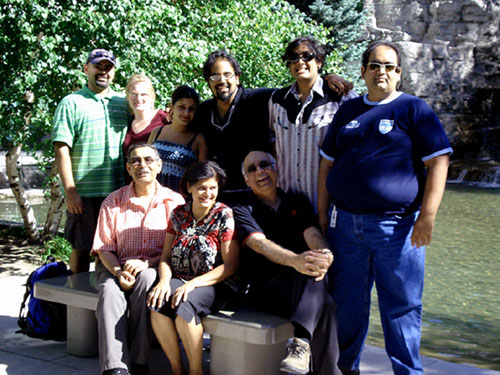
Our family at home in Toronto 2008

Our family at home in Toronto 2008
Amit, Heather, Fuzz, Aj, Jiv, Shiva, Rampa, Sero, Jai